
Two Louisiana home care companies paid $446,334 in back wages and liquidated damages after the Department of Labor found they had misclassified 88 workers as independent contractors. Not a Fortune 500 problem. Two small businesses that paid straight time for overtime hours and called the workers contractors.
That kind of mistake rarely shows up on a compliance checklist until it already happened. It builds quietly. A growing team hires faster than it documents, a screening tool gets bolted on without anyone checking what happens after the AI-sourced candidate gets an offer, and a contractor relationship that started clean drifts into something a labor board would call employment.
Here’s what HR compliance for small businesses covers, where the expensive mistakes hide, and the exact steps to fix each one before an agency finds it first.
What HR Compliance Covers for Small Businesses
HR compliance sounds like a single category. It isn’t. It’s a stack of separate legal exposures that only look related because they all live under one HR umbrella.
The Four Pillars of Small Business HR Compliance
Worker classification compliance determines whether someone is legally an employee or a contractor, and it’s judged on the actual working relationship, not the label on the contract. Wage and hour compliance governs overtime, minimum wage, and how those rules change the moment a hire crosses a state or country line. Global employment compliance applies the instant a small business hires someone outside its home country, whether that’s one contractor in Portugal or a five-person distributed team. AI hiring compliance is the newest and fastest-growing category, covering what happens when an algorithm screens, scores, or rejects a candidate. Four categories, four failure modes.
Many small businesses handle the first category reasonably well and never think about the other three until something forces the issue. That’s the pattern worth breaking. This guide treats each one as its own discipline instead of one generic checklist.

Why Small Business HR Compliance Gets Harder as You Scale
Headcount isn’t the real variable. Compliance exposure scales with the number of jurisdictions, tools, and worker types a company touches. A ten-person team hiring only W-2 employees in one state carries far less exposure than a six-person team running contractors across four countries and an AI screening stack, even though the second team is smaller.
Worker Classification Compliance: Employee vs. Contractor Rules
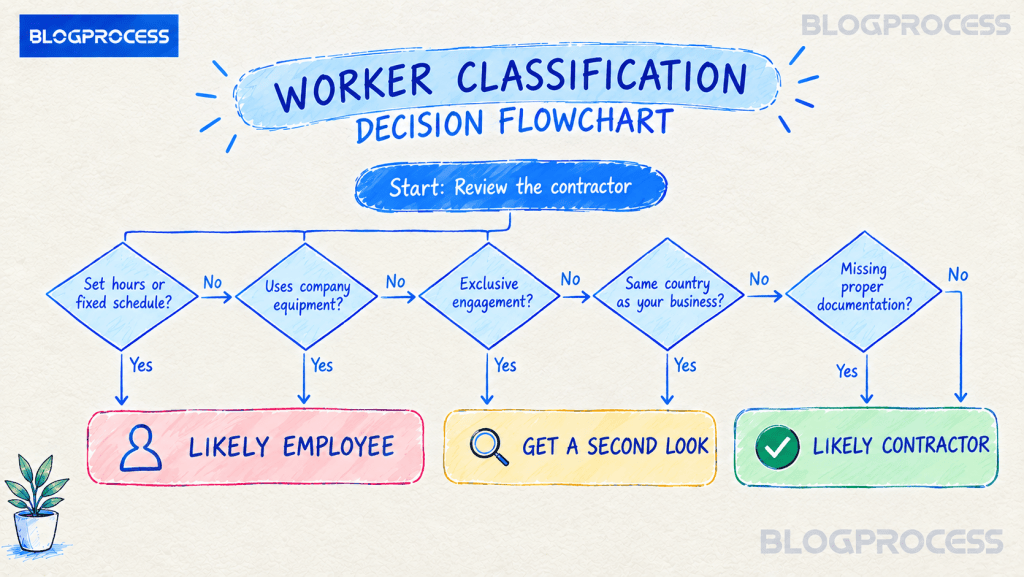
Misclassification happens when a company treats a worker as an independent contractor while the actual relationship legally makes them an employee. The label doesn’t matter. Set hours, company equipment, exclusive engagement, ongoing supervision: any of these can tip a contractor into employee territory, regardless of what the contract says.
Three agencies, one mistake. The Department of Labor pursues back wages, the IRS pursues unpaid taxes, and states pursue their own separate penalties, all from a single misclassified worker. The IRS charges roughly 1.5% of wages paid plus a share of unpaid FICA taxes for an unintentional mistake under Internal Revenue Code Section 3509, and that relief disappears if the IRS judges the mistake intentional, leaving the employer liable for the full taxes owed, with criminal charges possible in rare, willful cases. California alone can add $5,000 to $25,000 per violation for willful misclassification under California Labor Code 226.8.
This isn’t a US-only problem. The UK Supreme Court ruled unanimously in 2021 that Uber drivers were workers entitled to minimum wage and paid holiday, not self-employed contractors, a decision estimated to affect around 60,000 drivers. Spain hit delivery platform Glovo with a €450 million demand from Spanish Social Security in 2025 over riders classified as self-employed, on top of earlier fines exceeding €200 million for the same issue. Any company running the same contractor agreement across multiple countries is making the same bet those platforms made, that a template written for one jurisdiction holds up everywhere else.
How to Test Worker Classification Compliance Step by Step
Run this test on every contractor relationship at least once a quarter, and immediately whenever the scope of the work changes.
- List every active contractor and how long each has been engaged. A contractor who started as a short-term project but has now run six months or longer needs a second look regardless of the original contract terms.
- Check for set hours or fixed schedules. A true contractor generally controls when the work gets done, not the company.
- Check for company equipment and exclusive engagement. A worker using company-issued hardware and working exclusively for one client starts to look like an employee under most classification tests.
- Check whether the country of the working relationship matches the contract’s assumptions. A contractor agreement written for US law doesn’t automatically hold up somewhere with different labor protections.
- Document the actual working relationship, not just the paperwork. Courts and agencies weigh control, integration, and economic dependence over the title on an invoice.
- Flag anyone who fails two or more of the checks above for reclassification or a move to an Employer of Record. Catching the problem internally, before an audit does, opens the door to programs like the IRS Voluntary Classification Settlement Program, which lets employers self-correct for a fraction of the cost of a forced reclassification.
Wage and Hour Compliance for Small Businesses
Wage and hour compliance covers overtime, minimum wage, and how those obligations shift the moment a hire crosses a state or country line. It’s an old problem. It’s also a pillar where enforcement data is public.
The U.S. Department of Labor’s Wage and Hour Division recovered more than $259 million in back wages for nearly 177,000 workers in fiscal year 2025, the highest recovery figure since 2019. Small businesses aren’t automatically exempt. The DOL’s official list of “low wage, high violation” industries includes food service, with 4,088 violations resolved in fiscal year 2025, and healthcare, with 2,370.
Step-by-Step: Auditing Wage and Hour Compliance
- Confirm exempt versus non-exempt status for every role. A job title alone doesn’t determine overtime eligibility. The duties performed do.
- Check overtime calculations against the correct state rate, not just federal. Several states set a higher minimum wage or a stricter overtime trigger than the FLSA baseline.
- Check which state’s rules apply to remote and multi-state employees. They generally follow where the work is performed, not where the company is headquartered.
- Audit meal and rest break compliance in any state that mandates them. A missed break can trigger penalty pay independent of the hours actually worked.
- Cross-check timekeeping records against payroll runs for a sample pay period. Gaps between logged hours and paid hours are where most wage claims start.
- Flag any pattern that repeats across multiple pay periods, rather than treating each discrepancy as a one-off. A repeated pattern is evidence an agency can use to argue the violation was willful.
One line, one checklist. The country-line version of this problem runs through the hiring structure decision instead, covered in the next section.
If an audit turns up past mistakes, the Department of Labor’s PAID program lets eligible employers self-report and resolve minimum wage and overtime violations without litigation. State law claims stay intact.
Global Hiring Compliance: EOR and Contractor Platforms Compared
Once a small business hires outside its home country, the compliance question changes shape entirely. An Employer of Record, known as an EOR, and a contractor management platform are the two most common answers, though an owned entity or a unified platform fit specific stages better. Getting it wrong is costly.
EOR vs Contractor Platform vs Entity: Comparing Global Hiring Structures
An EOR becomes the legal employer in a country where your company has no entity, handling statutory benefits, local labor contracts, and payroll tax filings on your behalf. A contractor management platform instead localizes contractor agreements and payments without creating an employment relationship at all, which works until the relationship starts looking like employment under local law.
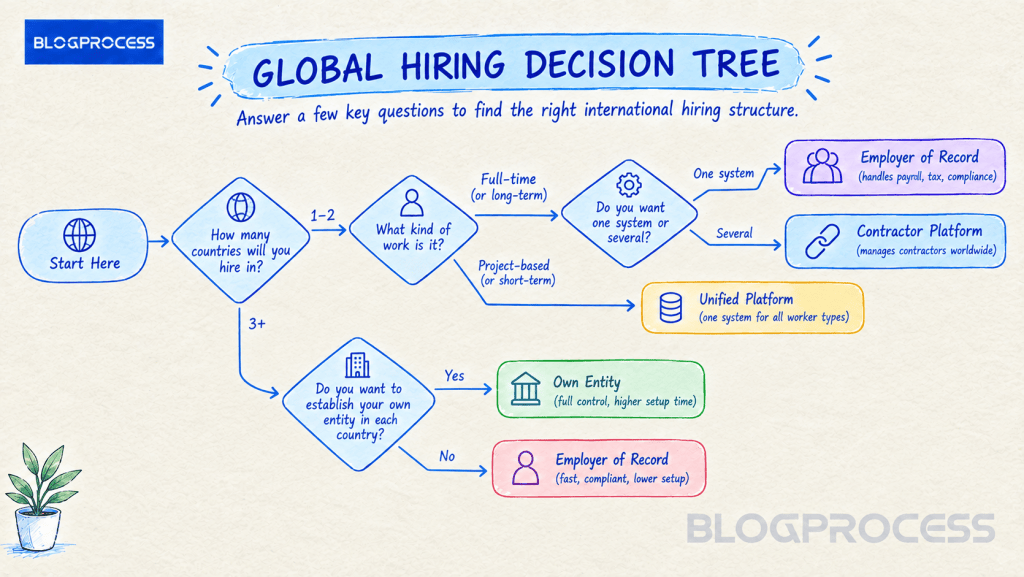
A local legal entity gives full control but takes the longest and costs the most to stand up. There’s no free option. A unified platform sits on a different axis entirely: it doesn’t answer who the legal employer is, it answers how many separate systems the company has to run once that question is settled.
| Approach | Best For | What It Solves |
|---|---|---|
| Employer of Record | Full-time hires in countries without an entity | Legal employer status, statutory benefits, payroll tax compliance |
| Contractor management platform | Freelancers and short-term international contractors | Localized agreements, compliant payments, misclassification flagging |
| Own legal entity | Large, established teams concentrated in one country | Full control, but the slowest and most expensive to stand up |
| Unified workforce platform | Teams juggling HR, payroll, IT, and contractors together | One employee data layer instead of four disconnected systems |
Step-by-Step: Choosing an EOR or Contractor Platform for International Hiring
- Count how many countries you’re hiring in right now, and how many you expect to add in the next 12 months. A single country favors a lighter contractor tool. Multiple countries favor a platform with broad EOR coverage.
- Decide whether the role is full-time or project-based. Full-time, ongoing work in a country without an entity almost always points toward an EOR. Project-based work with a defined end date can often stay in contractor territory if the classification test above is clean.
- Check each platform’s entity model. Some EOR providers use 100% owned entities in every market, while others mix owned entities with third-party partners, which shifts part of the compliance burden to a partner you didn’t choose directly.
- Compare switching costs before signing, not after. Changing EOR providers can mean terminating and rehiring every employee, which can trigger a multi-week transition window with benefits lapses and visa complications for sponsored employees.
- Confirm whether contractor pricing or EOR pricing dominates your total spend, since the two products are priced completely differently and a platform that’s cheap for contractors isn’t necessarily cheap once you add EOR employees.
- Decide whether a unified platform is worth the tradeoff. A single system spanning HR, payroll, IT, and contractor management eliminates the manual syncing a standalone stack requires, at the cost of losing some best-in-class depth in any one category.
Two platforms lead this space. Deel and Remote.com are the two most established EOR platforms for growing companies, and they solve the same problem in meaningfully different ways, particularly around entity structure and contractor pricing. For teams that want HR, payroll, IT, and contractor management under one roof instead of stitched together, Rippling’s unified platform approach is worth understanding before committing to a point solution for each function separately.
AI Hiring Compliance: Where the Real Risk Lives
AI use across HR tasks climbed from 26% in 2024 to 43% in 2025, according to SHRM’s 2025 Talent Trends report. Compliance didn’t keep pace. That gap between adoption and oversight is where the exposure sits.
The Regulatory Deadlines Every Small Business Should Track
It’s rarely the screening tool itself that creates liability. In a ResumeBuilder survey of 948 business leaders, 47% said AI hiring tools can introduce age bias, 44% cited socioeconomic bias, and 30% cited gender bias. Separately, SHRM reports that 19% of organizations using automation or AI in hiring say their tools overlooked or screened out qualified applicants. Not edge cases.
Regulators and courts have noticed. Track them by deadline, not by headline.
| Jurisdiction or Case | What It Requires | When It Applies |
|---|---|---|
| EU AI Act | High-risk rules for employment AI, including risk management, documentation, data quality, logging, and human oversight | December 2, 2027 |
| NYC Local Law 144 | Bias audit, public audit information, and required candidate/employee notices for covered AEDTs | Enforceable since 2023 |
| Colorado SB 26-189 | Disclosure and a right to request human review | January 1, 2027 |
| California ADMT rules under the CCPA | Notice, opt-out, access, and related requirements for covered ADMT uses in significant decisions. | July 1, 2027 |
| Mobley v. Workday | Opens the door to screening vendors, not just employers, being named as liable parties | Ongoing litigation |

Step-by-Step: Auditing Your AI Hiring Stack for Compliance
- List every AI tool touching your hiring funnel, from job description generation to resume screening to interview scheduling and final scoring.
- Note whether a human reviews the output before a decision gets made, or whether the tool runs unchecked because nobody was assigned ownership of that review step.
- Confirm candidates are told when AI is involved in screening. NYC Local Law 144 already imposes requirements on covered automated employment decision tools. The EU AI Act’s Article 50 transparency obligations began applying in August 2026, while Colorado’s new automated decision-making requirements and California’s ADMT requirements introduce additional obligations beginning in 2027.
- Check whether your screening vendor publishes bias audit results. If they don’t, ask directly, since NYC’s own enforcement of its bias audit law was found “ineffective” by a December 2025 state comptroller audit, and employment lawyers expect stricter enforcement in response.
- Trace what happens after a candidate is selected, not just how they were found. A fast AI-sourced hire in a new country still needs a compliant employment structure behind it.
- Fix any tool with no human review in the loop before doing anything else. The ResumeBuilder survey found 21% of companies let AI reject candidates at every stage without human review, and the EU AI Act requires human oversight of high-risk systems.
Building an HR Compliance Program: Step by Step
Most compliance failures aren’t dramatic. They’re the result of a decision that made sense at ten employees quietly becoming wrong at thirty. Building a real program means reviewing the right things at the right stage instead of running one generic annual checklist.
First, take stock. Then the last four steps turn that snapshot into a program that keeps working after this audit is over.
Step-by-Step: Setting Up HR Compliance From Scratch
- Audit every current worker’s classification using the six-point test above, and flag anyone ambiguous for reclassification.
- Map every country and state you currently employ or contract in, since wage, hour, and benefits rules shift at both borders.
- Inventory every AI tool touching hiring, performance, or termination decisions, and confirm a human reviews each one’s output.
- Choose a global hiring structure before the next international hire, not after. Decide in advance whether new international roles default to an EOR, a contractor platform, or a new entity.
- Set a recurring review cadence tied to headcount milestones, not just a calendar date, since drift tends to happen between planned reviews.
- Assign one owner for compliance decisions. Diffuse ownership is how AI tools run unchecked and classification drift goes unnoticed.
- Document everything as you go, since the paper trail is what turns a judgment call into a defensible decision if it’s ever questioned.
HR Compliance Checklist by Company Growth Stage
What needs review changes by stage, and applying a fifty-person checklist to a ten-person team wastes time the team doesn’t have.
| Company Stage | What to Review | Common Mistake at This Stage |
|---|---|---|
| 1 to 10 employees | Contractor classification, basic wage and hour rules | Treating long-term contractors as permanent 1099s |
| 10 to 25 employees | First international hire, AI tool adoption | Hiring abroad as a contractor instead of through an EOR |
| 25 to 50 employees | Multi-state or multi-country payroll, bias audit exposure | No human review on AI screening decisions |
| 50+ employees | Full entity structure decisions, vendor liability | Assuming a screening vendor absorbs your legal exposure |
Four signals mean a review shouldn’t wait for its next scheduled date:
- A contractor relationship crosses six months. That’s the point where the classification test above needs a fresh look, not the annual calendar.
- The company makes its first hire in a new country. The hiring structure decision needs to happen before the offer goes out, not after.
- A new AI hiring tool gets adopted, even informally. It needs a place in the tool inventory and a human reviewer assigned before it touches a single candidate.
- Headcount crosses one of the stage thresholds above. That’s exactly when the next stage’s common mistake stops being theoretical.
Questions People Ask About HR Compliance for Small Businesses
Do I need a local legal entity in every country I hire in? No. That’s the entire point of an Employer of Record. An EOR already has the legal entity in that country, so you hire through them instead of setting one up yourself, trading a per-employee monthly fee for the cost and time of registering a foreign subsidiary.
What happens if a company is found to have misclassified a worker? It varies by country. The common thread is retroactive exposure: back taxes on wages already paid, statutory benefits owed as if the person had been an employee the whole time, and fines stacked on top of both, typically triggered by an audit, a labor board complaint, or the worker themselves filing a claim.
Is AI hiring legal for a small business in 2026? Generally, using AI in hiring is not automatically illegal, but the requirements depend on the tool, the decision it influences, where the business and candidates are located, and which laws apply. NYC already regulates covered AEDTs, while additional U.S. state and EU requirements apply on different timelines.
How is an EOR different from a contractor management platform? The difference is legal status. An EOR makes you a legal employer in a country through a local entity, with full statutory benefits and payroll tax compliance. A contractor management platform localizes contractor agreements and payments without creating an employment relationship, which is a lighter lift but only appropriate when the relationship genuinely stays contractor-shaped.
How often should a growing company review its HR compliance posture? At minimum, every time headcount crosses a meaningful threshold or the company hires in a new state or country for the first time. Annual reviews miss it. The drift that matters most happens in between.
If an AI hiring vendor’s tool turns out to be biased, is my company liable or the vendor? Both, potentially. Discrimination law has traditionally held the employer responsible even when a third-party tool caused the disparate impact, and the Mobley v. Workday case has opened the door to vendors being named as liable agents too. Buying the tool doesn’t transfer your legal exposure to the company that built it.
HR Compliance Laws and Official Sources: Where to Read Them Yourself
Summaries go stale. Statutes, regulations, and court rulings are where the actual rules live. Every law and ruling cited in this guide is listed below with a link to the official or primary source, so you can read the text before relying on anyone’s summary, this one included.
| Law or Source | What It Covers | Read It At |
|---|---|---|
| Internal Revenue Code Section 3509 | Reduced employer tax liability rates when a worker is treated as a contractor instead of an employee | Cornell Legal Information Institute |
| IRS Voluntary Classification Settlement Program | A self-correction route for reclassifying contractors as employees | IRS.gov |
| California Labor Code 226.8 | Civil penalties for willful misclassification | California Legislative Information |
| Fair Labor Standards Act employer toolkit | Federal minimum wage, overtime, and recordkeeping basics | U.S. Department of Labor |
| DOL PAID self-audit program | Resolving wage and hour errors without litigation | U.S. Department of Labor |
| Uber v Aslam, UK Supreme Court | Worker status for platform drivers | UK Supreme Court |
| EU AI Act, Regulation 2024/1689 | High-risk classification for employment AI | EUR-Lex |
| NYC Local Law 144 | Bias audits and candidate notice for automated hiring tools | NYC Department of Consumer and Worker Protection |
| State Comptroller audit of Local Law 144 enforcement | Findings on how the law is enforced | Office of the New York State Comptroller |
| Colorado SB 26-189 | Disclosure duties and a consumer right to request human review for automated decisions | Colorado General Assembly |
| CCPA automated decisionmaking regulations | Notice, opt-out, and risk assessment duties for automated tools | California Privacy Protection Agency |
| Mobley v. Workday | Vendor liability for AI hiring bias claims | Proskauer analysis |
This guide is general information, not legal advice. Laws change. They also vary by state, so confirm what applies to your situation with an employment attorney.
Conclusion
There’s no single fix. HR compliance for a small business is worker classification, wage and hour rules, global hiring structure, and AI hiring oversight, and the mistakes in each category get expensive in different ways at different stages.
It’s a habit. Not a tool, not a policy. Audit classification and wage practices on a schedule, choose a hiring structure before the next international hire rather than after, and put a human in the loop on every AI hiring decision, run on a cadence tied to real growth milestones instead of a once-a-year calendar reminder.
Start here. Find the row in the growth stage table above that matches the company today, run that stage’s checklist first, and work outward from there.