A single misclassified contractor cost two Louisiana home care companies $446,334 in back wages and damages. Not a Fortune 500 mess, no just two small businesses that treated workers as 1099 contractors when the law said otherwise.
That’s not a rare story. It’s the norm.
Here’s what a misclassification mistake actually costs, where the exposure comes from, and what to check before your next hire crosses a border or a tax bracket.
What “Misclassification” Actually Means
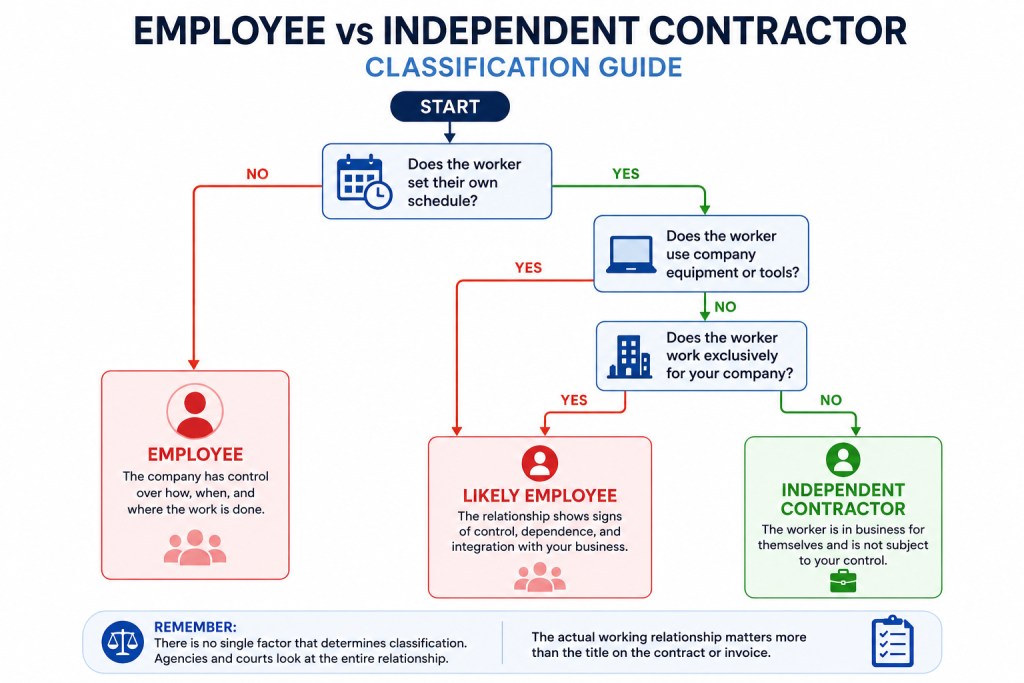
Misclassification happens when a company treats a worker as an independent contractor when the working relationship legally makes them an employee. Set hours, company equipment, exclusive engagement, ongoing supervision: any of these can tip a contractor into employee territory, regardless of what the contract says.
The label on the paperwork doesn’t matter. The actual relationship does. Courts and agencies look at control, integration, and economic dependence, not the title on the invoice.
This gets messier the moment a company hires across state lines or country borders. A contractor relationship that’s clean in Texas can fail the ABC test in California. A setup that works in the US can violate labor law entirely elsewhere, where the default assumption leans toward employee status.
Affiliate Disclosure: This article contains affiliate links. If you click through and purchase a plan, a commission is earned at no extra cost to you. The steps, observations, and recommendations are based on direct experience and are not influenced by the affiliate relationship.
Misclassification Risk Around the World
This isn’t a theoretical risk. The UK Supreme Court unanimously ruled in 2021 that Uber’s drivers there, an estimated 60,000 of them, were workers entitled to minimum wage and paid holiday, not self-employed contractors. In Spain, delivery platform Glovo faced a €450 million demand from Spanish Social Security in 2025 over riders misclassified as self-employed, on top of earlier fines exceeding €200 million for the same issue. Both companies eventually restructured their workforce models rather than keep fighting the classification in court.
Neither case was a company hiring one remote contractor. But the underlying problem scales down just fine: any company running the same contractor agreement across multiple countries is making the same bet Uber and Glovo made, that a US-style contract will hold up somewhere it was never designed for.
What Misclassification Actually Costs
The Department of Labor’s Wage and Hour Division recovered more than $259 million in back wages for nearly 177,000 workers in fiscal year 2025, the highest recovery since 2019. Average payout per worker: $1,465. And that’s just wages. It doesn’t touch penalties, legal fees, or the audit that triggered it.
The IRS runs a separate track under Internal Revenue Code Section 3509. For a mistake the agency considers unintentional, a company owes roughly 1.5% of the wages paid plus 20 to 40% of the FICA taxes that should have been withheld, on top of the employer’s full FICA share. Call that mistake willful instead of honest, and the math changes fast: 20% of wages, 100% of FICA taxes, and criminal fines up to $1,000 per misclassified worker.
California alone can add $5,000 to $25,000 per violation for willful misclassification under Labor Code 226.8, separate from anything the IRS or DOL collects.
Three agencies, three separate bills, one mistake.
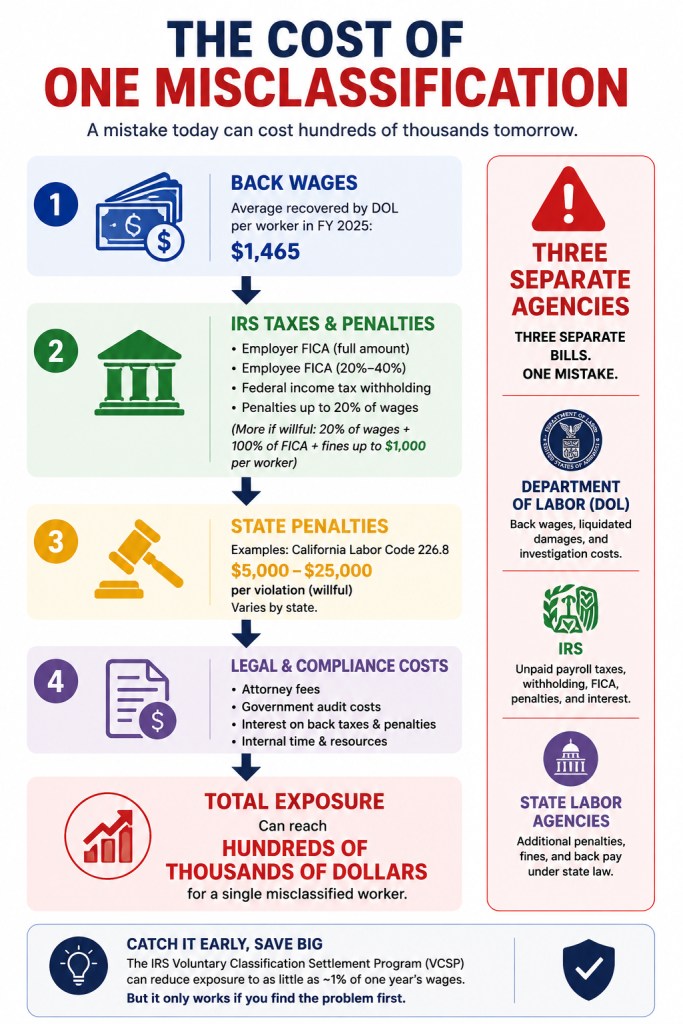
There’s a way to limit the damage if you catch the problem before an agency does. The IRS runs a Voluntary Classification Settlement Program that lets employers self-correct and pay a fraction of what a forced reclassification would cost, sometimes close to 1% of one year’s wages instead of the full penalty stack. The catch: it only works if you find the problem first. Waiting for an audit removes that option entirely.
Better than catching the problem early is never creating it. That’s the real fix, and it’s structural, not procedural.
Where Companies Actually Get Caught
Misclassification audits rarely start with a proactive government sweep. They usually start with a worker filing an unemployment claim, a disgruntled contractor filing a complaint, or a routine payroll audit that surfaces a pattern nobody flagged.
The DOL flagged food service and healthcare as “low wage, high violation” industries in its 2025 data, where over 4,000 and 2,300 violations respectively got resolved that year, with tens of millions recovered in each sector. But this isn’t an industry problem. It’s a scaling problem. The faster a company grows its remote or international workforce, the more classification decisions get made on autopilot, and the more exposure builds quietly in the background.
What Actually Reduces the Risk of Misclassification
A few things matter more than most compliance checklists suggest:
Match the classification to the country, not the US default. A contractor agreement written for US law doesn’t automatically hold up somewhere with different labor protections. Every country has its own test.
Document the actual working relationship, not just the contract. If a “contractor” reports to a manager on a fixed schedule using company tools, the paper trail won’t save you.
Review classifications when the relationship changes. A contractor who started as a short-term project often drifts into something closer to a full-time role. That drift is where most exposure builds.
Use a mechanism that classifies correctly by design, rather than hoping a template contract holds up in every jurisdiction you hire in.
The Misclassification Solution for Companies hiring intra-states or WorldWide
This is the exact gap an Employer of Record model closes. Instead of guessing whether a worker qualifies as a contractor in Germany, Brazil, or the Philippines, the company hires through a local entity that already carries the compliance burden. That’s a different risk profile than running the same US-style contractor agreement everywhere and hoping it holds. The classification decision stops being a judgment call your HR team makes on a case-by-case basis, and becomes something baked into the hiring process itself.
That’s the model Deel runs on. Instead of a company setting up entities in every country it wants to hire in, or leaving classification to a template contract, Deel employs the worker locally through its own entity and handles the payroll, tax, and labor law compliance that comes with it. The company gets the working relationship it wants. The worker gets the legal status the local law says they’re entitled to. Neither side is betting on a contract holding up in a jurisdiction it wasn’t written for.
The speed of that setup matters too, since a lot of classification drift happens in the gap between “we decided to hire this person” and “the paperwork actually reflects how they’re working.” Deel says a compliant new hire can be fully onboarded in about five minutes, because the paperwork itself is localized automatically to wherever the person is, right down to state-specific documents and minimum wage rules inside the US. Identity checks and background screening run inside that same flow instead of sitting in a separate queue, benefits enrollment kicks off automatically once the start date hits, and equipment, system access, and initial task assignments get set up without someone on the HR team chasing it down manually after the fact.
See how Deel handles compliant global classification across more than 150 countries, with the entity structure and paperwork already built for each one. It’s the difference between reacting to a misclassification claim after the fact and never generating grounds for one in the first place.
Conclusion
If your company has contractors working set hours, using company equipment, or taking direction the way an employee would, that relationship is worth a second look before an agency takes it for you. Misclassification rarely gets caught early. It gets caught expensive.
Pull your contractor list. Check who’s been in the role more than six months. For anyone who fails that check in a country you don’t have an entity in, that’s exactly the gap an Employer of Record model was built to close.
Classification is one piece of a bigger compliance picture. See our complete guide to HR compliance for small businesses for how it fits with wage and hour rules, global hiring structure, and AI hiring compliance.