
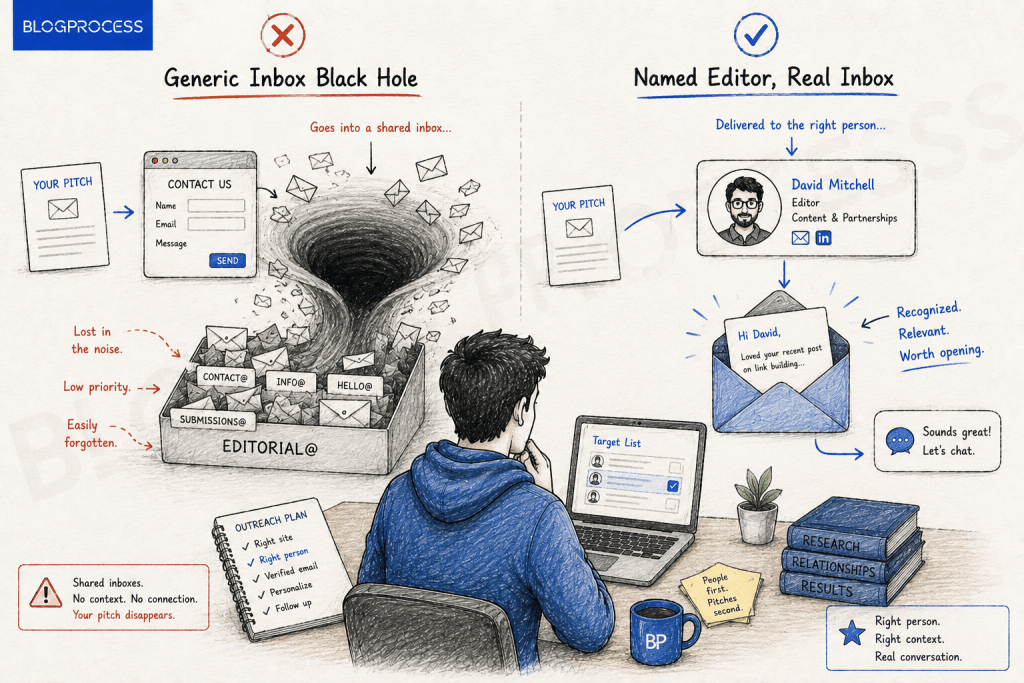
Picture two pitches going out the same week. One sits in a shared inbox until it’s forgotten. The other lands in an editor’s actual inbox, spelled right, referencing a post she wrote last month, and gets a reply before the day is out. Same offer. Same niche. Same pitch, almost word for word.
I’ve watched this play out enough times that it stopped feeling like luck. The difference was never the pitch. It was who received it.
A generic “write for us” inbox usually has three people half-watching it and nobody fully owning it. An editor who actually approves guest content, addressed by name, with proof you read her last post, is a different conversation entirely.
Guest posting still works for building authority and picking up real backlinks. What doesn’t work anymore is guessing. Contact forms get ignored. Generic inboxes get autoresponders. And a bounced email doesn’t just waste your time, it dings your sender reputation for every campaign after it.
So here’s the actual stack I run before a single pitch goes out, broken into stages, not tools.

Why Most Guest Post Outreach Fails Before the Pitch Is Written
Bad targeting kills more campaigns than bad writing does. Not even close. It’s tempting to blame the subject line first. Pull the send logs on a stalled campaign and the real problem is almost always sitting one layer earlier.
Four patterns show up over and over in failed campaigns:
- Wrong target. The site accepts guest posts in theory but hasn’t published one in over a year.
- Wrong contact. The email goes to editor@ or contact@ instead of the person who reviews submissions.
- Wrong data. The email address is guessed, scraped, or years out of date, so it never lands at all.
- Wrong fit. The pitch topic doesn’t match what the site actually publishes, so even a delivered email gets skipped.
Fix those four and the pitch itself barely needs to be clever. It just needs to arrive.
Stage 1: Building a Guest Post Outreach Target List Worth Pitching
I don’t start with a list of sites I like. I start with a list of sites that are demonstrably still running guest content, which is a different filter entirely.
My shortlist criteria, in order:
- Published a guest post or contributor byline in the last 90 days
- Ranks for at least one keyword I’d want to target
- Has a domain that hasn’t been flagged for link spam
- Publishes consistently, not in bursts followed by six-month gaps
- Covers a topic close enough to mine that a pitch doesn’t need to be forced
- Has comments or social shares suggesting a real audience, not a ghost blog
A site can look great on paper and still be dead. I check the archive page, not the homepage, before it earns a spot on the list.

Stage 2: Finding the Right Guest Post Outreach Contact
This is where most people stop too early. They find the site, they find a generic contact form, and they submit the pitch into a black hole.
Instead, I’m hunting for a name. Bylines on recent guest posts usually point to who manages the program. Team pages and “meet the editor” sections do the same. LinkedIn searches for “content” or “editor” plus the company name close most of the remaining gaps.
The goal here isn’t an email address yet. It’s a name and a role. That comes next.
Stage 3: Email Verification for Guest Post Outreach
No name means no pitch. Once I have one, I need a real way to reach them, not a pattern guess like firstname@domain.com that bounces half the time.
This is where I run enrichment. FullEnrich sits in this exact spot in the workflow, taking a name and company and pulling a verified email through a waterfall of data providers instead of returning one guess and hoping. I’ve stopped hand-guessing formats entirely, because a single bounce report from a bad batch of guesses does more damage to deliverability than a slow week of outreach ever would.
I treat this stage as non-negotiable. A pitch to a verified inbox and a pitch to a guessed one look identical to me when I hit send. They do not look identical to my sender reputation, and a spam-folder problem rarely traces back to the plugin people blame first.
| Method | Typical Hit Rate | Bounce Risk | Time per Contact |
|---|---|---|---|
| Manual guessing | Low | High | 3 to 5 minutes |
| Scraped email lists | Low to moderate | High | Instant, but stale often |
| Waterfall enrichment (FullEnrich) | High | Low | Under a minute |
I still hand-verify the highest-priority targets before sending, because no data source bats a thousand. But enrichment gets me from a blank field to a real, checkable address without burning an afternoon per contact.
Stage 4: Personalization Research for Guest Post Pitches
Verified contact in hand, I spend a few minutes on the part that actually earns the reply: proof I read their site.
My quick-hit checklist before writing the pitch:
- Their most recent guest post, so I don’t repeat a topic they just ran
- One post of theirs I can reference specifically, not vaguely
- Their submission guidelines, word count, and formatting rules
- Whether they link out to sources or keep everything internal
- Any stated topics they’re actively looking for
- Their typical turnaround time from pitch to publish
- Whether they credit guest authors with a bio link or just a byline
Seven items, five minutes, and the pitch stops sounding like a template.
Putting the Guest Post Outreach Stack Together
Here’s the order, stage by stage, with what each one is actually solving.
| Stage | Goal | Output |
|---|---|---|
| Target list | Filter for active, relevant sites | Shortlist of 15 to 20 sites |
| Contact identification | Find the decision maker | Name and role |
| Enrichment and verification | Get a working email | Verified contact record |
| Personalization research | Earn the reply | Pitch-ready notes |
I run this as a batch, not one site at a time. Thirty minutes of target list building, then a focused pass through enrichment, then personalization notes done in one sitting while the research is still fresh in my head. Outreach is exactly the kind of open-ended task that quietly burns bloggers out when it’s left unstructured, so batching it isn’t optional for me anymore.
A stripped-down version of the pitch template I actually send:
Subject: Quick idea for [Site Name] readers, saw your [recent post title] pieceHi [First Name],I read [specific post title] last week and the section on [specific detail] stuck with me, particularly [one sentence reaction].I write about [topic] and had an idea that fits what you cover: [one-sentence pitch angle].Happy to send a full outline if this sounds like a fit for your upcoming schedule.[Your name]
Short, specific, and it proves I did the reading before I asked for anything.
What Changed When I Fixed My Guest Post Outreach Data
Run the math on a normal month and the gap is hard to ignore. Say you send 60 pitches, a realistic monthly volume for someone running outreach solo alongside everything else.
| Metric | Guessed or scraped emails | Verified through enrichment |
|---|---|---|
| Pitches sent | 60 | 60 |
| Bounce rate | 38% | 3% |
| Emails actually delivered | 37 | 58 |
| Reply rate on delivered emails | 8% | 15% |
| Replies received | 3 | 9 |
| Guest post acceptance rate | 40% | 40% |
| Published guest posts | 1 | 3 |
| Research time per contact | 4 minutes | 1 minute |
| Monthly research time | 4 hours | 1 hour |
Same pitch, same 60 targets, same 40% acceptance rate once someone actually replies. The only thing that moved is what happens between “I have a name” and “the email lands.” Fixing that one stage roughly triples published output while cutting the research time in half again.
The bounce rate matters beyond the wasted sends too. Most sending platforms treat 2% to 5% as a warning zone and anything above 5% as an active deliverability problem, the kind that gets a domain throttled or pushed to spam regardless of what’s in the email. If your outreach domain shares infrastructure with your regular blog email, it’s worth checking whether your DNS setup is actually protecting your sender reputation before you scale up a campaign. A 38% bounce month isn’t just a bad month of replies, it’s the kind of number that drags down inbox placement on every other campaign running through that same domain for weeks afterward.

Run the Math on Your Own Guest Post Outreach List
You don’t need my numbers, you need yours. The formula is the same regardless of list size:
Published guest posts ≈ pitches sent × delivery rate × reply rate × acceptance rate
Pull your delivery rate from your last campaign’s bounce report, your reply rate from your sent folder, and your acceptance rate from however many pitches actually turned into a published post. Plug in your own figures and you’ll usually find the same thing I did: the delivery rate is doing more damage than the pitch copy ever was.
The Pre-Send Checklist for Guest Post Outreach
Run every contact through this before it leaves your outbox. Skip a line and you’re back to guessing.
- Site published a guest post or contributor byline in the last 90 days
- Contact is a named person, not a shared inbox
- Email came from verification or enrichment, not a guessed pattern
- You’ve read their most recent post, not just their homepage
- Your pitch references something specific from that post
- Submission guidelines are followed, including word count
- Subject line names the site or the post you’re referencing
Seven checks, maybe two minutes once it’s a habit. Miss the third one and the other six stop mattering, since a bounced email never gets read no matter how good the rest of the research is.
Questions People Ask About Guest Post Outreach Research
Is it worth enriching contact data for a small batch of only 10 to 15 pitches? Yes. Bounce damage to sender reputation doesn’t scale down with list size. A handful of bad sends in a small batch can hurt deliverability just as much as a bad batch of 100.
How do I know if a guest post target is actually still active? Check the archive page for posts in the last 90 days, not just the homepage. A stale “write for us” page with no recent contributor bylines is a dead end even if the form still works.
Should I always try to find a named contact instead of using the contact form? Almost always. Named contacts convert far better than shared inboxes, since a form submission has no accountability attached and gets deprioritized behind actual correspondence.
What’s the biggest mistake people make in guest post outreach? Sending the pitch before verifying the contact. A great pitch to a dead inbox never gets read, no matter how good the personalization is.
How much time should this research stack actually take per target? Roughly 10 to 15 minutes per site once you’ve built the habit, split across target qualification, contact identification, verification, and personalization notes.
Does enrichment replace manual verification entirely? No. It replaces guessing. I still spot-check the highest-priority contacts by hand before a big send, since no single data source is perfect for every name.
Conclusion
The pitch is the last five percent of guest post outreach, not the first. Everything that makes a pitch land happens before you write a single word of it: a real target, a real name, a real email, and enough context to sound like you actually read the site.
If your reply rate has stalled, don’t rewrite the pitch yet. Pull your last campaign’s bounce report first. That’s usually where the actual problem is hiding, the same place mine was.
If you’re also cleaning up subscriber data on the email side, the same instinct applies there too, worth a look if you haven’t audited what your list is actually telling you recently.