

One domain isn’t a strategy. It’s a single point of failure with a nice DNS record attached to it.
Most people picking a sending domain for cold outreach stop at the TLD question. Should it be .com, .net, or something more direct like .email? That’s already answered. But it skips the part that determines whether a campaign survives past week two: how many of these domains you need running at once, and when to add another one.
Why Cold Email Domain Variations Exist In the First Place
A cold email domain is not your main business domain. That part is settled. Good reason, too. Sending unsolicited outreach from the same domain that hosts your website and receives customer replies puts your primary domain’s reputation directly in the blast radius of every bounce, spam complaint, and blocklist hit a cold campaign generates.
So the practice became: buy a lookalike domain, redirect it to your main site, and send from that instead. Fine. But cold email domain variations, plural, exist because a single satellite domain runs into the exact same volume ceiling your primary domain would have. It just delays the problem by one hop.
The real question isn’t domain versus no domain. It’s volume. Specifically, how many domains your send volume requires before mailbox providers start treating your traffic as suspicious regardless of how clean your copy is.
How Sending Volume Decides Your Cold Email Domain Count
Every domain, brand new or aged, has a daily sending ceiling during warmup. Push past it and deliverability drops fast, sometimes within a single send. This ceiling is set by the receiving mailbox providers, not by you, and it’s the actual variable that determines domain count. Not gut feeling. Not what a competitor is doing.
A few things shape where that ceiling sits for any given domain:
- Domain age. A domain registered last week has almost no sending history, so providers start it at a fraction of what an aged domain can handle.
- Warmup pace. Ramping too fast looks like a burst of spam, even if every recipient opted in somewhere along the way.
- Mailbox provider mix. Gmail, Microsoft, and smaller regional providers all apply different thresholds, so a list heavy on one provider behaves differently than a mixed list.
- Engagement signals. Opens, replies, and manual “not spam” clicks feed back into the ceiling itself. Ignore this and a domain that looked healthy on day ten can choke by day twenty.

Multiply your target daily send volume against a realistic per-domain ceiling and the domain count falls out of the math on its own. No guessing. This is the calculation most advice skips entirely in favor of a flat number pulled from nowhere, one that ignores what you’re trying to send.
Cold Email Domain Variations and Reputation Isolation
Volume is one reason to add domains. Isolation is the other. It’s the one that saves a campaign when something goes wrong.
Picture a satellite domain taking a spam complaint spike, maybe from a bad list segment or an overly aggressive subject line. Bad luck happens. If that domain is the only one carrying your outreach, the whole campaign stalls while you rebuild trust from a damaged starting point. If that same volume is spread across several domain variations for cold email, the damage stays contained to one domain while the rest keep sending clean.
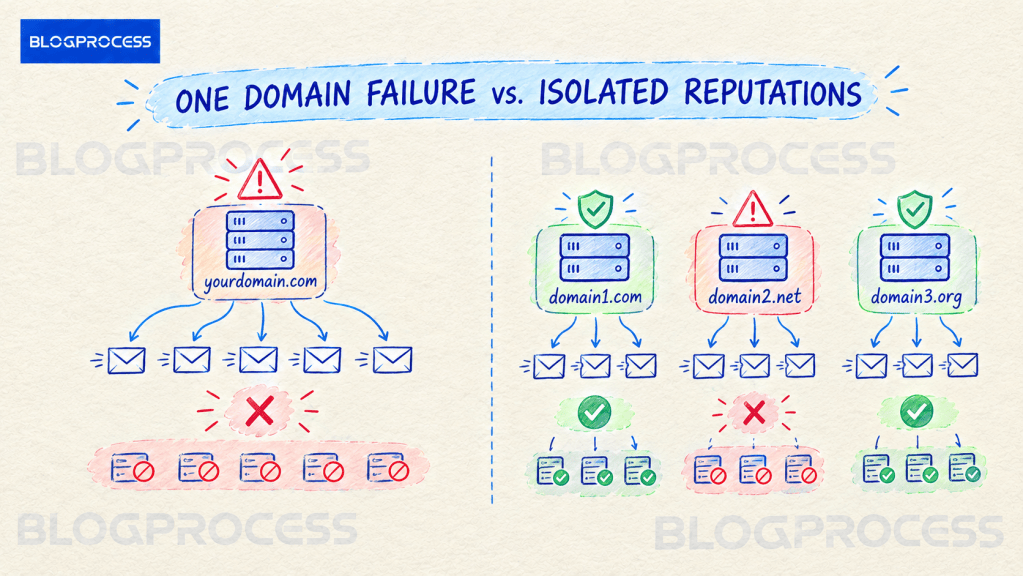
This is the same logic behind getting your DNS authentication records right on every domain you add, not just the first one. A domain variation with a broken SPF record or missing DKIM signature doesn’t protect anything. Quite the opposite. It just adds another point of failure to the pile, and mailbox providers notice unauthenticated sending patterns fast.

Treat every new sending domain as its own reputation, built up on its own warmup schedule, authenticated with its own records. Not a shared pool. Not an afterthought bolted onto the main one. This is one piece of the broader email marketing automation stack worth getting right before volume scales.
Cold Email Sending Volume vs Recommended Domain Count
This is a rough baseline, a starting point rather than a hard rule, since list quality and engagement rates shift the math in both directions. Nothing here is gospel. It assumes the common setup of three to five mailboxes running per domain, each capped near 30 to 50 sends a day once warmed. The counts below build in headroom for isolation on top of that raw capacity. A single fully warmed domain could often carry the lower end of a range alone, but spreading it protects you if that one domain takes a hit.
| Daily Send Volume | Recommended Domain Count | Why |
|---|---|---|
| Under 50/day | 1 to 2 | Fits inside what a single domain handles safely, even one still in warmup |
| 50 to 150/day | 2 to 4 | One warmed domain could often carry this alone, splitting it keeps a single reputation hit from taking out your whole volume |
| 150 to 400/day | 4 to 8 | Needs several domains staggered across different warmup stages so none carries the full load alone |
| 400 to 800/day | 8 to 14 | Requires an automated rotation system across domains and mailboxes, not manual tracking |
| 800+/day | 14 or more | Effectively requires dedicated infrastructure, since manual rotation breaks down at this scale |
And a second angle worth checking, since the ceiling itself isn’t the same everywhere:
| Mailbox Provider | Typical New Domain Daily Ceiling During Warmup |
|---|---|
| Gmail / Google Workspace | Roughly 20 to 50 emails a day, ramping up over about 2 to 4 weeks |
| Microsoft 365 / Outlook | A similar 30 to 50 a day curve, also over roughly 2 to 4 weeks |
| Smaller regional providers | Less standardized data available, but generally more forgiving during the early ramp |
Real-world guidance on these ceilings disagrees more than most articles admit. Some sources put a warmed domain’s safe volume well above what’s shown here, others well below. Once a domain is fully warmed rather than still ramping, its safe ceiling climbs well past these starting numbers regardless of whose figures you trust. Treat this table as directional. The shape matters most. Low and slow at the start, scaled up only as engagement holds steady.
Take a list of 3,000 leads you want to reach inside six weeks, sending five days a week. Simple math. That’s 3,000 divided by roughly 30 sending days, so about 100 emails a day. The first table puts that in the 50 to 150 range, which means two to four domains covers it without pushing any single one past a safe warmup pace.
Setting Up Cold Email Domain Variations Without Breaking DNS
Adding domains without a system is how people end up with five half-configured subdomains and no idea which one is actually authenticated. Keep it structured.
- Register the variation. Keep it close to your brand name so it still reads as legitimate to a recipient scanning a sender address.
- Set up its own SPF, DKIM, and DMARC records. No shortcuts here, and no copying one domain’s records onto another without adjusting the selector.
- Warm it independently. New domains don’t inherit trust from older ones you already own, even if they’re registered under the same account.
- Log its sending volume separately. A shared rotation tool should track each domain’s individual metrics, not just a combined total.

A basic SPF record for the mail subdomain of a newly registered sending domain, not a subdomain of your main business domain, looks like this:
mail.yourdomain.com. IN TXT "v=spf1 include:_spf.yoursendingtool.com ~all"
One record, one tool. But stack multiple tools onto one record without checking the lookup count and you’ll run into the same SPF ceiling that breaks authentication for every email sent from that domain, which is a mistake worth avoiding on every domain you stand up, not just the first.
Three Domain Variations for Cold Email: Your Practical Floor
Run the table above first. Your volume decides your number. But treat three as the floor underneath that math, not a substitute for it.
The floor matters even when the table says one or two would technically cover your volume. A single domain has no fallback the moment something goes wrong, and a bad list segment or one aggressive subject line is all it takes. One strike and you’re out. Three gives you room to isolate that risk, room to test which domain performs best with your list, and a spare that keeps sending while you fix whatever tripped up the other one.
If your volume genuinely calls for more, the table is your real number. Trust it. Don’t cap yourself at three once the math says otherwise, and don’t stack ten unused domains with no warmup history behind them either. That just sits there as dead weight and occasionally reads as a red flag to providers scanning for suspicious new domains tied to your business.
One exception. If you’re still testing whether cold email is even worth doing, a handful of emails to gauge interest before committing to it as a channel, one domain is fine for that. The floor applies once you’re running this as an actual program, not a two-week experiment.
Questions People Ask About Cold Email Domain Variations
Do I need a separate domain for every cold email tool I use? No. The domain and the sending tool are separate layers. One properly authenticated domain can route through a single tool. What needs multiplying is domain count relative to volume, not domain count relative to tool count.
Can I reuse an old, unused domain instead of buying a new one? Sometimes, if it has clean history and no prior spam flags. Check its reputation with a domain health tool before assuming age alone makes it safe, since a domain with a bad past can be worse than a fresh one.
How long does warming a new cold email domain actually take? Typically two to four weeks of gradually increasing volume before a domain reaches a stable sending ceiling. Some providers recommend stretching that to six or eight weeks for a more cautious ramp, and engagement quality can shorten or extend the window either way.
What happens if I skip warmup and send at full volume immediately? Deliverability collapses fast, often within the first few sends. Getting removed from a formal blocklist can actually happen within days. What takes longer, often longer than the warmup period itself, is rebuilding the trust you burned with Gmail and Outlook, since those providers don’t forget bad behavior just because a list stopped flagging you.
Should each domain variation redirect to my main website? Generally yes, for legitimacy. One caveat: if you’re running several domain variations at once, don’t make all of them redirect identically to the same page at the same time. That uniform pattern across a batch of new domains is exactly the kind of correlated signal reputation systems watch for. Stagger when each one goes live, or vary the landing page slightly.
Is buying more domains ever the wrong move? Yes, if volume doesn’t justify it. Unused domains with no consistent sending history don’t help and can look like a domain farm to providers watching for exactly that pattern.
Conclusion
The number of sending domains you need comes from your volume math and your appetite for reputation risk, not from a flat rule copied off a forum thread. Do the math. Work out your realistic daily send volume, check it against a domain’s warmup ceiling, and let the table decide your number.
Treat three as the floor under that number, not a replacement for it. That’s the whole strategy. Authenticate every domain properly before it sends a single message, and track each one’s performance separately so you catch a reputation problem on one before it spreads to the rest.