

I didn’t burn out because I was tired. I burned out because I was doing six different jobs and calling all of them “blogging.”
It took me about a year to notice. I slept fine most nights. I wasn’t skipping meals. By every self-care checklist I’d read, I was doing everything right. I still hit a wall where opening my laptop on a Monday felt like dread instead of momentum. The problem was never the hours. It was that none of those six jobs had an edge to them.
Why the Standard Burnout Advice Doesn’t Stick
Most “avoid burnout as a blogger” posts hand you the same five things: sleep more, take breaks, set boundaries, exercise, don’t work weekends. None of that is wrong. It’s also not the reason solo bloggers burn out, which is why the advice gets followed for two weeks and quietly dropped.
Self-care advice treats burnout like a battery problem, something you recharge with rest. For a one-person operation, burnout is usually a structure problem. You can sleep eight hours a night and still burn out if the job itself has no natural stopping point.
| Symptom-Level Fix | Structural Fix | |
|---|---|---|
| Targets | Exhaustion, mood, sleep | The workload itself |
| Feels like | A wellness routine | An audit |
| Sticks after | A week or two, usually | Ongoing, once changed |
| Actually addresses | How you feel about the job | What the job requires |
The Six Roles You’re Doing Without Noticing
“Blogger” is a job title that hides at least six actual jobs inside it. Most burnout checklists only ever address one of them: the writer.

- Writer, the part everyone thinks the job is
- Editor, catching your own mistakes with no second set of eyes
- Promoter, social posts, engagement, the constant low hum of visibility work
- Email marketer, list building, sends, deliverability
- Tech support, hosting issues, plugin updates, the site breaking at 11pm
- Bookkeeper, invoices, affiliate payouts, tracking what’s actually working
I counted mine once, on a bad week. Fourteen hours went to writing. Eleven went to the other five roles combined, and I hadn’t budgeted a single one of them.
What My Actual Week Looked Like
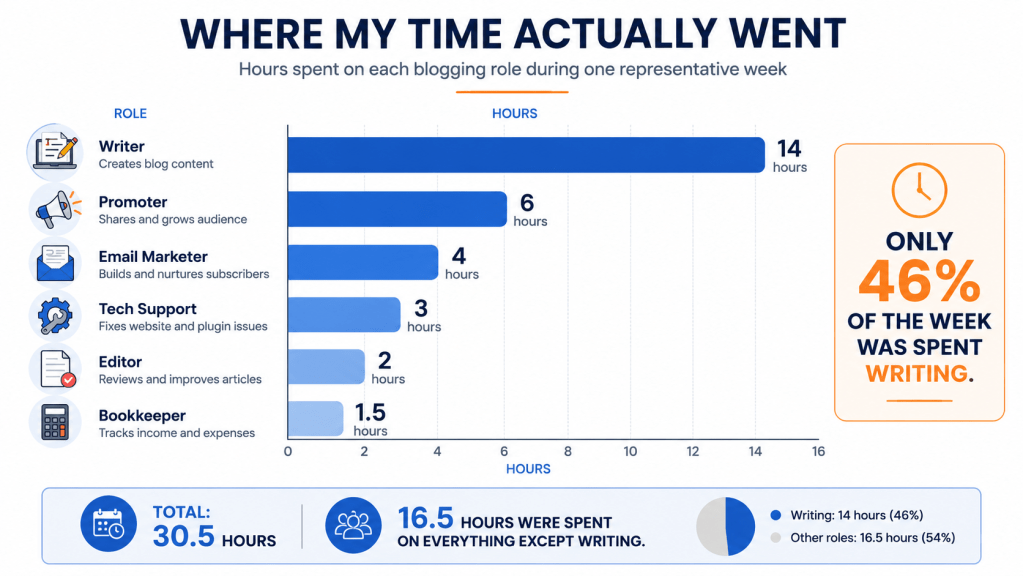
Here’s the breakdown from that week, because vague numbers don’t make the point the way specific ones do.
| Role | Hours That Week | Was It Planned? |
|---|---|---|
| Writer | 14 | Yes |
| Promoter | 6 | No |
| Tech support | 3 | No, a plugin conflict ate an afternoon |
| Email marketer | 4 | Partially |
| Editor | 2 | No |
| Bookkeeper | 1.5 | No |
Twenty-five hours went somewhere other than writing, and every single one of those hours felt like an interruption rather than part of the job. That’s the tell. When five-sixths of your roles show up as surprises instead of scheduled work, the calendar was never built to hold the actual job in the first place.
The “No Finish Line” Problem
A blog post is never actually finished. It can always be updated, repromoted, refreshed, repurposed into something else entirely. That’s a genuine strength of blogging as a format. It’s also exactly why the job has zero natural stopping points unless you build some in yourself.
Most jobs with a shift end when the shift ends. A one-person blog doesn’t clock out. There’s always one more post that could go out, one more subject line to test, one more old article that could be updated. Nothing tells you “that’s enough for today” except a boundary you set yourself, and if you never set one, the job just expands to fill every open hour.

The Actual Structural Checklist
Skip the self-care list for a minute. Run your operation through this instead:
- Can you hit your publishing cadence at 70% effort, or does every single post require a maximum push?
- Do you have a real backlog of ideas, or are you starting from a blank page most weeks?
- Is there one task you’re doing manually right now that could be templated or automated?
- Is there a task you’re doing daily that could realistically happen weekly instead?
- Do you have anyone else touching any part of this operation, even occasionally?
- Could you disappear for a week without the whole thing stalling?
If you answered no to more than two of those, the problem probably isn’t your sleep schedule. It’s that every part of the operation still runs through you alone, at full capacity, with no slack built in anywhere.
The One-Week Audit
The checklist above is a gut check. If you want actual numbers instead of a feeling, this takes one week.
Keep a running log, even a plain note on your phone works, and every time you switch tasks, jot down which of the six roles you just stepped into and roughly how long you were in it. Don’t try to be precise to the minute. Round to the nearest half hour and move on.
At the end of the week, tally the hours per role. Two things usually show up. First, one role almost always eats far more time than you’d have guessed if someone asked you cold. Second, the roles you never planned for, tech support especially, tend to show up as the biggest surprise, exactly like they did in my own breakdown above.
That tally is the actual input for deciding what to fix. Guessing at which role is the problem usually points at writing, since it’s the most visible. The log almost never agrees.
Physical Health Still Matters. It’s Just Not the Whole Fix.
None of this means sleep, posture, and screen breaks don’t matter. They do. Five Health Tips Every Blogger Shouldn’t Ignore covers the basics worth having in place regardless of what else changes.
The distinction is which problem those habits actually solve. They make a heavy workload more tolerable. They don’t make the workload lighter. I spent close to a year assuming better habits would eventually fix the dread I felt opening my laptop, and they didn’t, because the habits were never the thing that was broken.
What Actually Breaks First
When a one-person blog goes under, it’s rarely one big failure. It’s usually a handful of small structural gaps that finally catch up at once, which is exactly what 7 Mistakes That Will Kill Your Blog and Even Your Business walks through in detail, and the same kind of thing that shows up when nobody’s checked for broken internal links in a year because there was never a scheduled slot to do it in.
The overlap with burnout is direct. A missed publishing cadence, an abandoned guest post pipeline, a backup plan that only exists in your head: those aren’t separate problems from exhaustion, they’re the same root cause showing up in two different places. The Essentials of Blogging – Part1 is worth revisiting here too, since a lot of the foundational structure that prevents burnout later gets skipped in the excitement of starting a blog in the first place.
The Cheapest Role to Hand Off First
If you can only fix one thing, don’t start with writing. Writing is usually the role you actually want to keep doing, and it’s the hardest to hand off without the blog losing its voice.
Start with promotion or content sourcing instead. Effective Tricks to Interest More Guest Bloggers on Your Blog is one of the lowest-cost ways to offload the “sourcing new content” half of the writer role without touching your own voice at all. A handful of reliable guest contributors doesn’t just fill the calendar. It buys back the exact hours that were going to the role nobody budgeted for in the first place.
Why Handing Off Feels Riskier Than It Is
Most solo bloggers know, on some level, which role they should hand off first. Most don’t do it anyway, and the reason is rarely logistics. It’s that handing off any part of a one-person operation feels like admitting the operation can’t stay entirely yours.
That feeling is worth naming, because it quietly blocks fixes that would otherwise be easy. A guest post that isn’t in your exact voice feels like a small failure, even when readers never notice the difference. An automated email feels less “authentic” than one you wrote fresh, even though most subscribers can’t tell and don’t care. The resistance is protecting a standard nobody but you is actually holding the operation to.
The test that’s worked for me: would a reader who likes your blog notice or care about this specific change? Most of the time, for the roles worth handing off first, the honest answer is no. The only person who’d notice is the one who was doing all six roles alone.
Building In Stopping Points
Beyond handing off a role entirely, some of this comes down to changing how you use material you already have. A newsletter built entirely from scratch every week has no stopping point either, and Repurpose Your Worst Blog Posts, Not Your Best Ones is a direct example of manufacturing one: instead of writing something new every single send, a chunk of that work gets pulled from material that already exists.
The same logic applies past newsletters. Look at your last quarter of posts and ask which ones could get a second life instead of starting fresh. Every piece of “reuse instead of recreate” work is one less thing that requires you at full capacity.
How You’ll Know It’s Working
Don’t measure this by how you feel in the first few days. A role you just handed off usually feels worse before it feels better, since you’re still watching it closely instead of trusting it.
Run the one-week log again about thirty days after making a change. Two numbers matter: whether the total hours in unplanned roles actually dropped, and whether the role you handed off shows up in the log at all anymore. If it’s still there at a similar hour count, it wasn’t handed off, it just changed shape. If the hours genuinely disappeared from your week, that’s the actual signal the fix stuck, regardless of how confident or nervous you felt about it along the way.
Questions People Ask About Blogger Burnout
Is burnout the same thing as just being tired? No. Tired is fixed by rest. Burnout persists even after a full weekend off, because the structural problem, too many roles with no edges, is still there Monday morning. If a week of good sleep doesn’t touch the dread, that’s the tell.
How do you tell the difference between burnout and just picking the wrong niche? Burnout tends to show up across every part of the job at once, including tasks you used to enjoy. A wrong-niche problem is usually narrower: you dread the writing specifically, but promotion or the business side still feels fine. If everything feels equally heavy, it’s more likely structural.
Does taking a full break actually help, or does it just delay the same problem? A break helps the way a nap helps a person who hasn’t slept in days, real relief, temporary result. Without a structural change waiting when you get back, the same six roles are still unbudgeted the moment you reopen the laptop.
What’s the first role to hand off if I can only fix one thing? Content sourcing through guest posts, usually. It’s the role with the clearest, lowest-cost path to offloading, and it directly reduces the writer role’s workload without touching your voice or requiring new software.
Do I need to hire someone to fix this, or can it be done solo? Most of this doesn’t require hiring anyone. Guest contributors, repurposing old content, and templating repetitive tasks are all things a solo operator can do without adding payroll. Hiring becomes relevant later, once the structural gaps are already smaller.
What if I’ve already tried cutting back and the dread came back within a month? That usually means a role got quietly picked back up rather than genuinely removed. Check whether the task you cut actually disappeared or just got absorbed back into your week without you noticing. Structural fixes need a way to stay cut, not just a one-time pause.
Is it normal for the log to show more unplanned hours than planned ones? It’s common, especially the first time you actually track a week instead of estimating it. Unplanned roles feel smaller in memory because they’re spread across small interruptions rather than one visible block, which is exactly why the log tends to surprise people more than the gut-check checklist does.
Should I track every week going forward, or just the one audit? One real audit is usually enough to find the problem. Ongoing tracking becomes useful again later, mainly as a way to confirm a fix actually held after thirty days, rather than as a permanent habit to maintain.
Conclusion
Fix the sleep and the screen breaks. They’re worth fixing regardless. Just don’t expect them to be the reason the dread goes away, because they were never the actual problem.
Pick one role from the list above, the one that isn’t writing, and hand it off, automate it, or cut it entirely for seven days. Not a whole system overhaul, just one week, one role. Notice what happens to how Monday feels.