

Every recruiting team I talk to has the same setup now. An AI tool screens resumes. Another schedules interviews. A third writes the job description.
Nobody planned this stack. It just piled up, tool by tool, over eighteen months, the way clutter does when you’re too busy to clean it out.
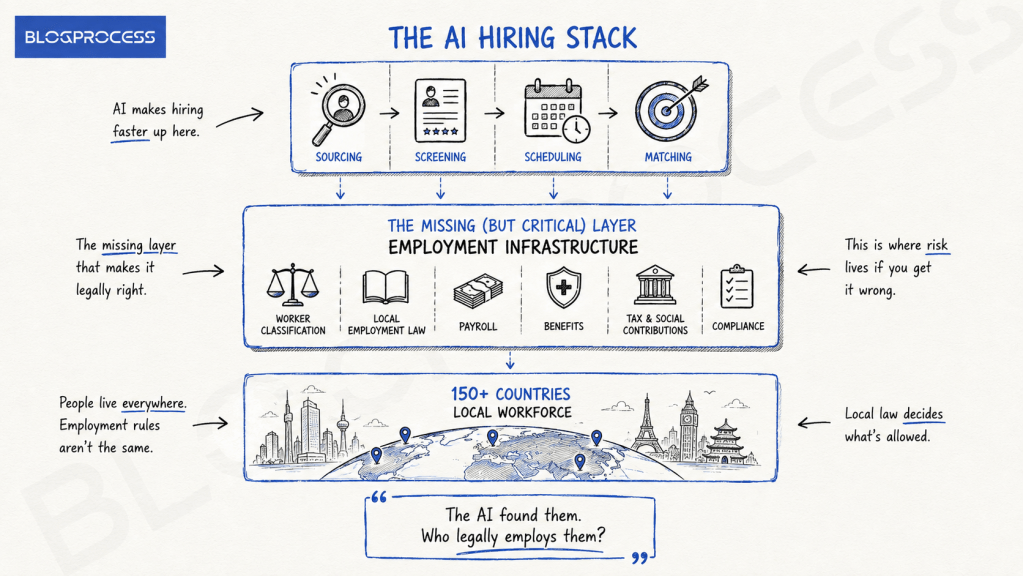
Here’s what almost nobody built on purpose: the layer that catches what happens after someone actually gets hired. That’s the gap this piece is about. It’s a bigger gap than most teams realize.
Adoption Moved Faster Than Anyone Planned
AI use across HR tasks climbed from 26% in 2024 to 43% in 2025, according to SHRM’s 2025 Talent Trends report.
That’s not a rollout. That’s a stampede.
The efficiency numbers explain why. 89% of HR professionals using AI in recruiting say it saves time or boosts efficiency, per SHRM.
Just over a third report lower recruitment costs too. Resume screening. Job description drafting. Candidate scheduling.
That’s where most of the investment went. Those are the parts that are cheap to automate and easy to demo in a board meeting.
The compliance layer underneath didn’t get the same money, or the same attention. Screening tools bolt on in an afternoon.
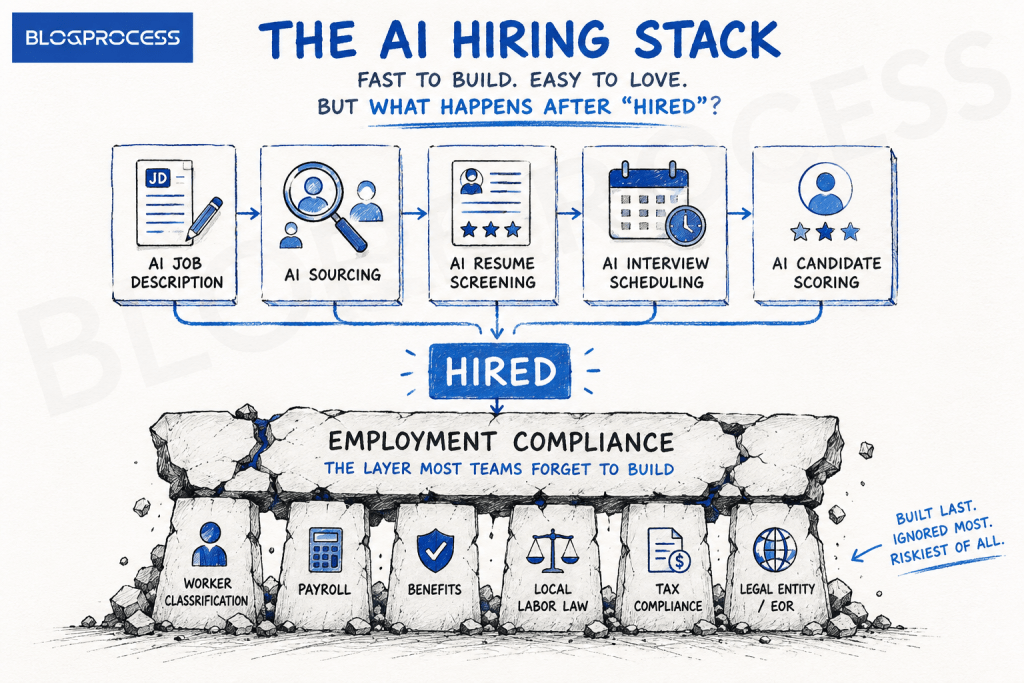
Getting worker classification and labor law right, in every country you hire from, doesn’t scale that easily. Nobody builds a slide deck about it.
It just stays quiet until it isn’t. By then you’re not talking to HR anymore. You’re talking to a labor attorney.
Screening Bias Isn’t a Hypothetical Anymore
The Bias Problem Nobody’s Fixed
Companies auditing their own AI screening tools keep finding the same ugly patterns. Roughly 47% report age bias.
44% report socioeconomic bias. 30% report gender bias, per ResumeBuilder’s survey of 948 business leaders.
Separately, 19% of organizations say their automated tools screened out qualified applicants entirely, per SHRM research. Not edge cases.
Nearly one in five, quietly rejecting people who should have gotten an interview.
Candidates have noticed, and they’re not thrilled about it. Two-thirds of Americans say they wouldn’t want to apply for a job at a company that uses AI to make hiring decisions, per Pew Research Center.
That’s not a fringe opinion. That’s the majority of your applicant pool, silently opting out before they even hit “apply.”
The Fraud Problem, Running the Other Way
There’s a mirror-image problem too. Per Greenhouse’s 2026 AI in Hiring Report, 86% of recruiters have caught or suspected candidate fraud in the past year.
Another 5% suspect it’s happening but can’t confirm it. More than half, 56%, believe AI makes it easier for candidates to cheat or fake credentials.
Fake references top the list of what recruiters actually catch. Resume exaggeration comes next. Candidates using AI live during interviews rounds out the top three.
So the stack cuts both ways. Employers use AI to screen faster. Candidates use AI to beat the screen.
Nobody fully trusts the process anymore, and honestly? That checks out.
The Regulatory Deadline Nobody’s Budget Accounted For
This part should worry finance more than HR.
The EU AI Act’s Deadline Just Moved
The EU AI Act classifies employment-decision AI as high-risk. That deadline just moved.
Brussels pushed it from August 2, 2026 to December 2, 2027. The vehicle was a formal amendment, the “Digital Omnibus on AI,” which entered into force in late July 2026.
The obligations themselves didn’t change. Just the runway. Fines still run up to €15 million or 3% of global turnover once the clock runs out, whichever hits harder.
One thing didn’t get pushed back: transparency requirements, like disclosing to a candidate that AI touched their application. Those stayed on the original August 2026 schedule. That part is already live.
New York’s Bias Audit Law Is Getting Teeth
New York isn’t waiting on Brussels either. NYC Local Law 144 requires an annual independent bias audit, a public summary of results, and candidate notice before any automated hiring tool touches a New York applicant.
It’s been enforceable since July 2023.
Here’s the twist nobody’s talking about enough. A December 2025 audit by the New York State Comptroller found the city’s own enforcement of that law “ineffective.” The audit cited broken complaint routing and superficial compliance reviews.
Employment lawyers are telling clients to expect the opposite in 2026: a tighter, more aggressive enforcement posture as the city corrects course.
Colorado and California Take Different Roads
Colorado just rewrote its rulebook. SB 26-189 replaced the state’s earlier AI Act in May 2026.
It swaps a broad regulatory framework for a narrower disclosure-and-human-review model. That takes effect January 1, 2027.
California’s approach runs through a different door entirely: privacy law. The California Privacy Protection Agency has issued Automated Decision-Making Technology regulations under the CCPA, finalized in 2025 and taking full effect for employment decisions on January 1, 2027.
They apply to any “significant decision,” employment included: hiring, promotion, discipline, compensation, and termination all count.
The Lawsuit Every HR Tech Vendor Is Watching
And then there’s the court case everyone in HR tech is quietly watching. Mobley v. Workday is now a certified nationwide age-discrimination collective action, covering applicants screened by Workday’s AI tools since September 2020.
The vendor-liability theory goes back to 2024. The court let the case proceed on the argument that Workday itself, not just the employers using it, could be held liable as an “agent” under federal discrimination law. That’s the part that should worry every HR tech vendor, not just Workday.
Then in March 2026, the court shut down Workday’s other major defense. Workday argued that age-discrimination protections only cover employees, not job applicants. The judge rejected that too, confirming applicants get the same ADEA protections as employees.
Stack both rulings together and the picture gets uncomfortable fast. A vendor can be on the hook as an agent, and an applicant, not just a hire, can bring the claim. Every HR tech vendor selling screening software just inherited a new category of legal exposure. So did every company that bought it.
| Jurisdiction | What It Requires | Status as of Mid-2026 |
|---|---|---|
| New York City | Annual bias audit, public summary, candidate notice | Enforceable since 2023; DCWP enforcement found weak, stricter posture expected |
| European Union | High-risk classification, human oversight, conformity docs | Deadline pushed to Dec 2, 2027; disclosure rules already active |
| Colorado | Disclosure + human-review pathway for adverse decisions | New SB 26-189 framework effective Jan 1, 2027 |
| California | ADMT regulation under CCPA/CPRA for “significant decisions” | Employment obligations effective Jan 1, 2027 |
| Federal (US) | Title VII disparate-impact liability still applies | No new federal AI-specific rule; existing law still binds |
| Any cross-border hire | Correct worker classification under local labor law | Ongoing exposure regardless of AI involvement |
Notice the pattern across every row. None of these rules actually target the screening tool itself.
They target what a company does with the tool’s output, and whether a compliant employment structure is standing behind the decision it helped make.
Where the Stack Actually Breaks
Talk to enough people running hiring-stack teardowns, and you’ll notice the failure point sits in the same place almost every time. It’s rarely the AI screening tool.
The model does what it was trained to do. The break happens downstream.
A company screens and hires someone in a country where it’s never legally employed anyone before. That’s a payroll tax question. A benefits question.
A worker classification question with real financial teeth behind it, not a hypothetical one. Misclassification penalties in some jurisdictions mean back taxes, statutory benefits owed retroactively, and fines stacked on top of both.
None of that shows up in a resume-screening dashboard. None of it shows up until an audit, a labor board complaint, or a disgruntled former contractor forces the issue.
A Scenario That Plays Out Constantly
An AI sourcing tool surfaces a sharp product manager candidate in Warsaw. The hiring manager loves them.
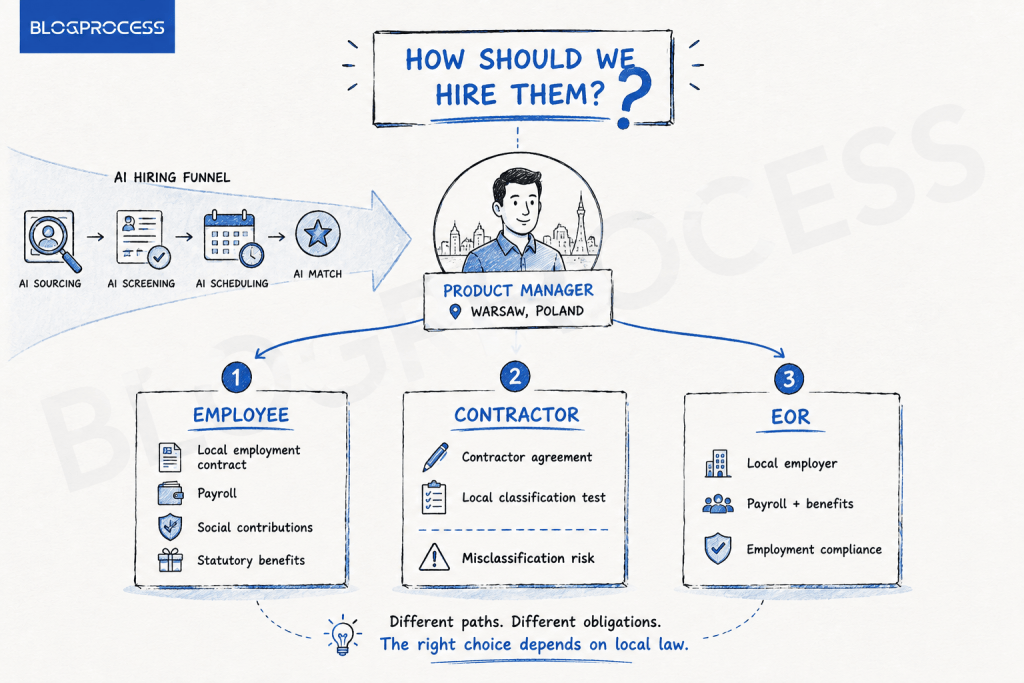
HR wants to move fast because good candidates don’t stay on the market long.
So the company brings them on as an “independent contractor,” the path of least resistance. No entity setup. No payroll registration. Invoice paid, done.
Except Poland, like most of the EU, has strict rules about what actually constitutes contractor status versus disguised employment. Fixed hours. Company equipment. Exclusive engagement. Integration into the team’s org chart.
Any one of those can flip the classification, regardless of what the contract says. If a labor authority decides that’s really an employment relationship, the company now owes back social contributions, potentially with penalties.
The “fast hire” turns into a multi-month legal cleanup.
AI can shrink your shortlist to five names by Monday morning.
It can’t tell you whether that hire needs a local entity, an Employer of Record, or a contractor agreement that actually survives a labor audit in the country where the person lives.
The Infrastructure Layer AI Hiring Stacks Are Missing
This is where a platform like Deel fits in. Not as another screening tool.
As the compliance and payroll layer underneath the hiring decision.
What Deel Actually Runs On
Deel runs on wholly-owned legal entities and payroll infrastructure across 150+ countries.
As of its most recent funding round, the company serves 37,000+ businesses and 1.5 million workers, processing roughly $22 billion in payroll annually.
Its Employer of Record product lets a company legally hire someone in a country where it has no entity of its own.
Deel becomes the local employer of record, handling statutory benefits, local labor contracts, and payroll tax filings.
The company doesn’t have to stand up a foreign subsidiary just to bring on one great hire in Lisbon or Manila.
Here’s the piece that connects directly to the AI screening problem above. Deel calls it Continuous Compliance: its always-on approach to applying local employment rules automatically across payroll, hiring, and contractor workflows as those rules change.
That matters because labor law doesn’t sit still. A classification test that was safe in Poland last year might not be safe this year.
A statutory benefit that didn’t exist in Brazil last quarter might exist now. Continuous Compliance is built to catch that drift before it becomes a violation, not after.
Four things that layer does for a team running an AI-heavy hiring funnel:
- Catches misclassification before it becomes a liability → contractor-versus-employee status gets checked against actual local labor law, not a generic US-centric checklist that happens to be wrong everywhere else.
- Keeps payroll compliant as the team scales → tax filings, statutory contributions, and benefits run automatically across 150+ countries, without a spreadsheet tracking each country’s quirks.
- Puts a real legal entity behind fast hires. An AI tool can surface a great candidate in Lisbon by Tuesday. Deel’s EOR is what actually gets that person legally on payroll by Friday, not three months from now once legal finishes reviewing entity setup.
- Gives HR one system of record across every hiring path. Whether the person ends up as an EOR employee, a compliant contractor, or a direct hire through a local entity, the paperwork lives in one place instead of scattered across a dozen local vendors.
What It Costs
| Product | Price | What It’s For |
|---|---|---|
| Employer of Record | $599 per employee/month | Hiring legally in a country with no entity of your own |
| Contractor Management | $49 per contractor/month | Compliant contractor agreements and payments |
| Global Payroll | $29 per employee/month + one-time entity setup fee | Running payroll once you have your own local entities |
Rates shift as Deel updates its plans, so confirm current numbers on their site before you budget anything against them.
Frequently Asked Questions About AI Hiring
Is AI hiring legal in 2026?
Yes, with conditions that vary by jurisdiction. The EU AI Act classifies employment-decision AI as high-risk, with those obligations now taking effect December 2, 2027 after a formal deadline extension in July 2026, and fines up to €15 million or 3% of global turnover once they apply. NYC Local Law 144 already requires annual bias audits and candidate notice for automated screening tools, and Colorado and California both have their own frameworks landing in 2027.
PS: This is general information, not legal advice. Consult an employment attorney for guidance specific to your situation.
What’s the biggest compliance risk in AI-driven hiring?
It’s rarely the screening tool itself. The bigger exposure is what happens after a candidate is selected: worker misclassification, payroll tax obligations, and statutory benefits owed in the hire’s country. AI speeds up who you find. It doesn’t cover how you legally employ them once you’ve found them.
Does Deel help with AI hiring compliance?
Deel isn’t a screening tool. It’s the compliance and payroll infrastructure that sits underneath the hiring decision, offering Employer of Record services across 150+ countries and Continuous Compliance updates as local labor laws change, so a fast AI-sourced hire can actually be onboarded legally.
How much do AI screening tools contribute to hiring bias?
Among companies auditing their AI hiring tools, roughly 47% report age bias, 44% report socioeconomic bias, and 30% report gender bias, per ResumeBuilder’s survey of 948 business leaders. Separately, 19% of organizations say their automated tools have screened out qualified applicants entirely, per SHRM research.
Do I need a local legal entity in every country I hire in?
No. That’s the entire point of an Employer of Record. An EOR already has the legal entity in that country, so you hire through them instead of setting one up yourself. The tradeoff is a per-employee monthly fee instead of the cost and time of registering a foreign subsidiary.
What actually happens if a company is found to have misclassified a worker?
It varies by country, but the common thread is retroactive exposure. Back taxes on wages already paid, statutory benefits owed as if the person had been an employee the whole time, and fines on top of both. It’s typically triggered by an audit, a labor board complaint, or the worker themselves filing a claim after the relationship ends.
If an AI vendor’s tool turns out to be biased, is my company liable, or is the vendor?
Both, potentially, and that’s the uncomfortable part. Discrimination law has traditionally held the employer responsible even when a third-party tool caused the disparate impact, and Mobley v. Workday shows the vendor can now also be named as a liable “agent.” Buying the tool doesn’t transfer your own legal exposure to the company that built it.
Conclusion
Run this audit this week, not next quarter. List every AI tool touching your hiring funnel, from job descriptions to final scoring.
Next to each one, note whether a human actually reviews the output before a decision gets made, or whether the tool just runs unchecked because nobody assigned ownership.
No human review anywhere on that list? Fix that first. It’s not optional. Regulators in New York, Brussels, and Colorado are all making that increasingly clear.
Now go one layer deeper. For every country you’re hiring in, or plan to hire in next quarter, do you actually know the answer to one question?
Is that an employee relationship or a contractor relationship under that country’s local law?
Not under US law. Under theirs.
If you’re guessing, you’re exposed. Not hypothetically. Financially, and possibly with a labor authority already circling.
AI made the top of the hiring funnel faster than it’s ever been. It never touched the compliance layer underneath, and the regulatory pressure on that layer is only building, not easing off.
That part still needs real infrastructure, not another dashboard. Not another AI tool promising to fix a problem that was never really about screening speed in the first place.
See how Deel handles global hiring compliance if that’s the gap staring back at you right now.
AI hiring compliance is one piece of a bigger picture. See our complete guide to HR compliance for small businesses for how it fits with worker classification, wage and hour rules, and global hiring structure.
Affiliate Disclosure: This article contains affiliate links. If you click through and purchase a plan, a commission is earned at no extra cost to you. The steps, observations, and recommendations are based on direct experience and are not influenced by the affiliate relationship.