Every “double opt-in vs single opt-in” post I read this month cited the same three stats and called it a day. Not one of them actually logged into Mailchimp, ConvertKit, MailerLite, or Beehiiv to check what those platforms ship as their default setting right now. So I did.
Turns out the “double opt-in is now standard” narrative you keep reading? It’s only half true. Two of the four platforms I checked default to single opt-in. Two default to double. Nobody’s default changed because of some industry-wide shift. It’s just different per platform, and always has been.
Here’s what each platform’s own documentation actually says right now, not what a two-year-old roundup claims it says.
What I Actually Checked
I’m not running a stats aggregation here. I pulled the current setting straight from each platform, not a third-party tutorial recycling a screenshot from two or three years ago, and I checked the last-updated stamp on every source before trusting it. Where an old tutorial disagreed with a platform’s current documentation, I went with whichever one had the more recent update date.
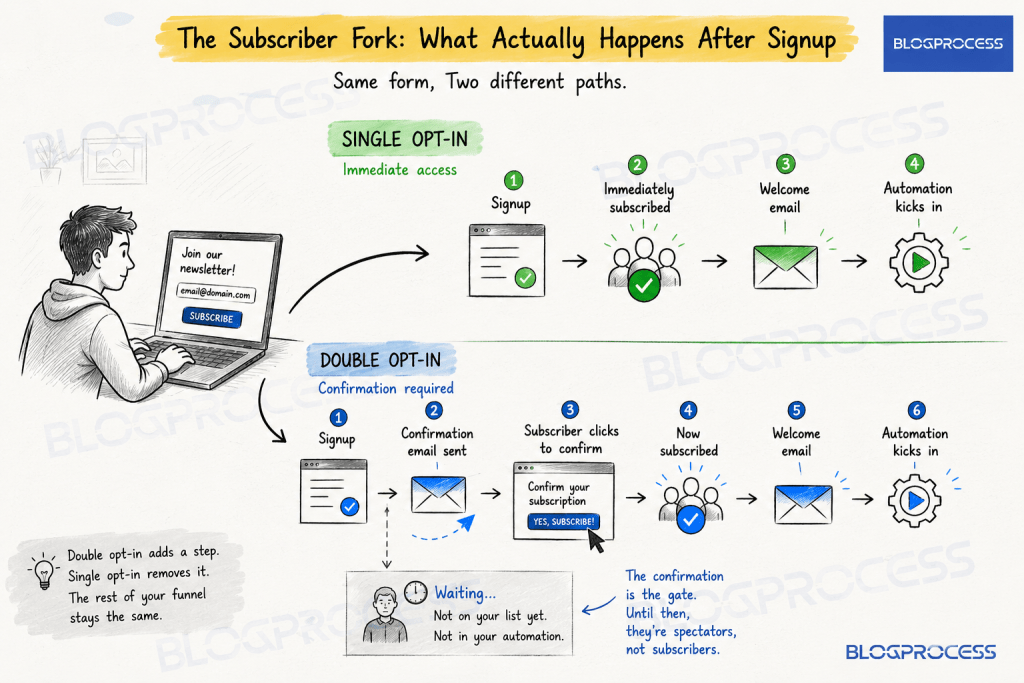
Four platforms. One question each: when someone fills out a signup form, do they land on your list immediately, or do they have to confirm first?
One honest caveat up front: platforms change these settings without warning, and I’m writing this the week of August 2026. If you’re reading this six months from now, the toggle in your own dashboard is the only source that actually matters, not this post.
Mailchimp Defaults to Single Opt-In (With One Exception)
Mailchimp’s own audience settings confirmed it straight up: new audiences use single opt-in by default. Fill out the form, you’re on the list. No confirmation email, no second click.
The exception took me longer to track down than it should have. If your primary contact address is based in the EU, Mailchimp may set some audiences to double opt-in automatically to stay ahead of GDPR expectations. Check your actual Opt-In Settings page rather than assuming, because this one’s account-specific and easy to miss.
Want double opt-in on Mailchimp? You’re flipping it on manually, per audience, under Audience settings → Form settings → Enable double opt-in.

ConvertKit (Now Kit) Ships Double Opt-In Out of the Box
ConvertKit rebranded to Kit a while back, and a chunk of the “current” guides floating around still use the old name and old screenshots. The setting hasn’t changed, though: forms default to double opt-in. Someone signs up, they get a confirmation email, and they’re not added to your list, or triggering any automation, until they click it.
Kit’s own help center, last updated about a month before I checked it, treats unconfirmed subscribers (people who filled the form but haven’t clicked confirm) as a distinct status from active subscribers. You can flip this off per-form under the form’s Incentive Email settings by selecting “auto-confirm new members,” but out of the box, it’s double.

MailerLite Defaults to Double, Too, But It’s Easy to Miss
Same story as Kit. MailerLite ships double opt-in by default and actively recommends keeping it that way, even though it’s not a GDPR requirement. Their own help center reasoning: it keeps spambots off your active list and protects your sender reputation before you’ve sent a single campaign.
Here’s the part I didn’t expect: customizing the actual confirmation email copy is a paid-plan feature. Free-plan users get MailerLite’s default confirmation email, full stop, which matters if you care about your first touchpoint looking intentional instead of generic. MailerLite’s own FAQ on this was updated within the last couple weeks, easily the freshest source of the four platforms.

Beehiiv Makes You Turn Double Opt-In On Yourself
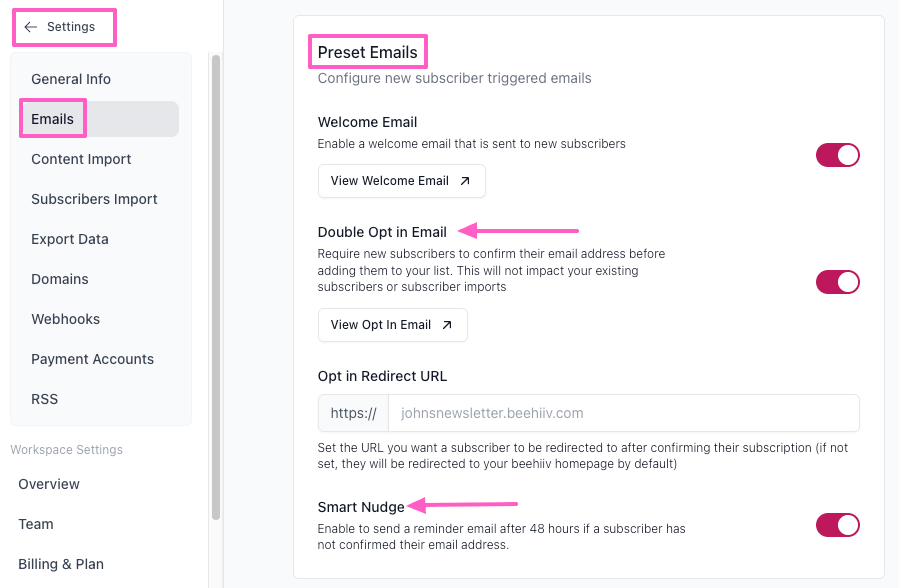
Beehiiv flips the pattern. Double opt-in exists, and beehiiv’s help docs call it a best practice, but it’s off by default at the publication level. You have to go into Settings → Emails → Preset Emails and toggle it on yourself.
There’s a detail here the other three platforms don’t really have: a per-form override. You can run double opt-in publication-wide but drop it for one specific high-intent form, or the reverse. Beehiiv also pairs double opt-in with something called Smart Nudge, an automatic follow-up reminder for people who signed up but never clicked confirm. Beehiiv’s own help article on this was last updated June 22, 2026, the most explicitly dated source of anything I checked.
To Sum up
| Platform | Default Setting | Where to Change It |
|---|---|---|
| Mailchimp | Single opt-in (EU-based accounts may default to double) | Audience settings → Form settings |
| ConvertKit / Kit | Double opt-in | Form settings → Incentive Email |
| MailerLite | Double opt-in | Subscribe settings → Double opt-in tab |
| Beehiiv | Single opt-in | Settings → Emails → Preset Emails |
What This Split Actually Means for Bloggers
Here’s the part the generic posts skip. The platform you picked years ago for pricing or email design has quietly been setting your list quality strategy for you this whole time, unless you went in and checked.
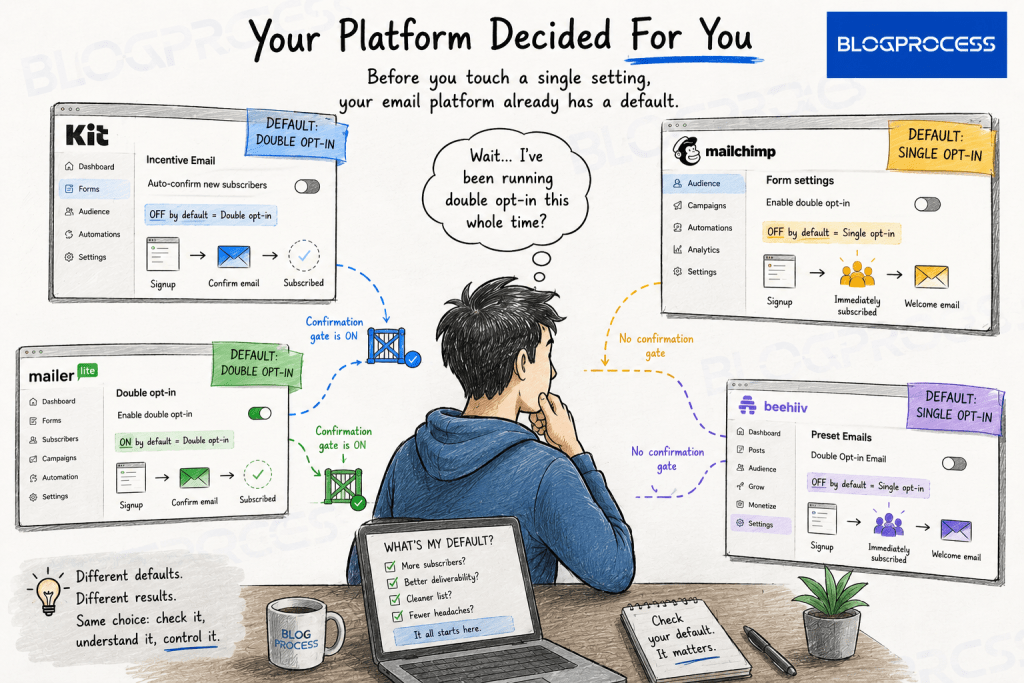
If you built your list on Kit or MailerLite and never touched the opt-in setting, you’ve been running double opt-in whether you meant to or not. If you’re on Mailchimp or Beehiiv, you’ve been running single. Neither is wrong. But you should know which one you’re running, because it changes how you read your own numbers. A 40% “confirmation rate” only exists if double opt-in is even turned on. If you’re on single opt-in and your open rates look weirdly low, the platform default might be part of that story, not just your subject lines.
A few things worth weighing before you flip the switch either way:
→ Traffic source matters more than the “right answer.” Cold traffic from ads or a viral post benefits from double opt-in’s filtering. Warm traffic from your own blog readers already self-selected once by finding your content in the first place.
→ Compliance pressure isn’t uniform. US-only lists under CAN-SPAM don’t face a legal double opt-in requirement. If a meaningful chunk of your list is EU-based, the consent-documentation argument for double opt-in gets stronger fast.
→ Confirmation email design isn’t optional if you go double. A generic, unbranded confirmation email gets ignored or deleted. If you’re adding friction, at least make the ask look intentional instead of like a system default nobody touched.
| Your Situation | Lean Toward |
|---|---|
| Mostly warm traffic from your own blog | Single opt-in, with a strong welcome email doing the filtering instead |
| Running paid ads or giveaways | Double opt-in, no real debate here |
| Meaningful EU audience | Double opt-in |
| Small list, testing content-market fit | Single opt-in, so you’re not losing 20-30% of early signal to a confirmation click |
I’m running a live test on one of my own opt-in forms next, tracking confirmation rate and 30-day engagement side by side against the baseline, using the same metrics I actually trust now rather than open rate. That’s part two. This post is just the part nobody else bothered to check first.
If deliverability is the part you’re actually trying to fix, my breakdown of email marketing automation tools I tested across WordPress and the DNS record setup piece both pair well with this one.
Questions People Ask About Double Opt-In vs Single Opt-In
Is double opt-in legally required in the US?
No. CAN-SPAM doesn’t require double opt-in. It requires a clear unsubscribe option and honest sender information, but confirmation-before-subscribe isn’t part of the law.
Which email platforms use double opt-in by default?
As of this check, ConvertKit (Kit) and MailerLite both ship with double opt-in turned on by default. Mailchimp and Beehiiv default to single opt-in instead, though Mailchimp may switch EU-based accounts automatically.
Does double opt-in hurt list growth?
Some, yes. Industry data generally puts the drop-off between signup and confirmation somewhere in the 20-30% range, though a well-designed confirmation email can push that number much closer to full conversion.
Can I change my opt-in setting after I’ve already built a list?
Yes, on all four platforms. Changing the setting going forward doesn’t retroactively confirm or unconfirm existing subscribers. It only affects new signups from that point on.
Is single opt-in bad for deliverability?
Not automatically. It’s riskier because it lets in fake or mistyped addresses that can spike your bounce rate. Combined with good list hygiene, like regularly removing unengaged subscribers, single opt-in can still perform fine.
Should I use different opt-in settings for different forms?
On platforms that support per-form overrides, like Beehiiv, yes, this is worth doing. Run double opt-in on your highest-friction, highest-value forms, like paid content or webinars, and keep lower-stakes forms such as a basic newsletter opt-in easier to complete.
Conclusion
The “double opt-in is now the standard” line gets repeated so often that nobody bothers to check it anymore. It’s not universal. It’s a per-platform default, and two of the four biggest tools bloggers actually use still ship single opt-in out of the box, exactly like they did years ago.
That matters more than it sounds like it should. If you’ve never opened your own opt-in settings, you’re running whatever your platform decided for you back when you signed up, and that decision got made for platform-wide reasons, not for your specific list or your specific traffic. Go check yours. It takes about ninety seconds, and it’s the kind of thing that’s easy to assume you already know until you actually look.