I used to open my dashboard every Tuesday morning and feel good about a 48% open rate. Then I actually checked how many of those opens were real. Not good. Roughly two-thirds of my list reads mail through Apple Mail, and Apple has been quietly marking almost all of those messages as “opened” since 2021, whether anyone reads them or not. My actual open rate, once you strip that out, was closer to half of what my dashboard was telling me.
I’m not alone. One deliverability consultant described a client celebrating a 42% open rate with an audience that was 65% Apple Mail, only to find real engagement sitting closer to 18% once the inflated opens were removed. A dead list, dressed up as a win. They’d been mailing people who’d checked out months earlier and calling it a success story.

Here’s what’s actually happening to open rate, what iOS 18 made worse this year, and which numbers I check instead now.
Why Open Rate Stopped Meaning Anything
What Apple Mail Privacy Protection Actually Does
Apple Mail Privacy Protection launched with iOS 15 in September 2021. When it’s enabled, and it’s presented as an opt-in choice the first time someone opens Apple Mail rather than a default setting, Apple’s own servers pre-load every email’s content, including the invisible tracking pixel that records an “open,” the moment the message arrives. That happens whether the recipient ever looks at the email or not. No reading required. Every message delivered to an MPP-enabled Apple Mail account registers as opened, so a list with heavy Apple Mail usage can show open rates 15 to 40 percent higher than actual reader behavior.
It only applies to Apple Mail specifically, not Apple devices generally, so someone reading your newsletter through the Gmail app on an iPhone isn’t affected the same way. But given how many people use Apple’s own Mail app by default, and given that it’s been the default choice for a large share of users who never went looking for a privacy toggle to switch on, the exposure is bigger than most bloggers assume until they actually check. Delivery, bounce, and click data remain unaffected by MPP, which is exactly why those numbers are worth leaning on instead.
What iOS 18 Changed On Top of That
The part that’s newer, and that most email marketing content still hasn’t caught up to, is Link Tracking Protection, added in iOS 18. It strips tracking parameters from links before they reach your analytics, the same UTM tags most of us rely on to see which email drove which click. So it isn’t only opens getting distorted anymore. A share of your click data is losing its attribution too, silently, without any indication in your dashboard that it happened.
This matters most for automation. Any welcome sequence, tag, or re-engagement flow you’ve built to trigger off an “opened” event is now firing on a mix of real engagement and Apple’s pre-fetching, which means some subscribers are getting follow-up emails they never earned by actually reading anything, while others who engaged through a stripped link aren’t getting credited for the click that should have moved them forward.

The Consent Layer Coming for Open Tracking Too
On top of the technical unreliability, there’s now a legal one. France’s data protection authority, the CNIL, published a formal recommendation on April 14, 2026, treating email tracking pixels the same way it treats cookies: reading information from a recipient’s device requires explicit, separate consent under Article 5(3) of the ePrivacy Directive, not the same blanket consent someone gave to receive your newsletter in the first place. Legitimate interest doesn’t cover it. The only exemptions are basic deliverability checks and security, not individual open tracking or personalization based on who opened what.
The deadline for existing EU contacts was July 14, 2026. For anyone collected after mid-April, there was no grace period at all. Italy’s data protection authority issued parallel guidance around the same time, and the UK’s PECR carries a near-identical standard. Not one country’s quirky interpretation. A direction several regulators moved in together, within weeks of each other.
One nuance worth knowing: this applies to individual-level tracking, not aggregated numbers. Campaign-level open rate that isn’t tied to identifying a specific person’s behavior falls outside the same consent requirement. It’s the “who opened this and when” tracking that needs consent, not a general campaign total.
Practically, this means a growing share of your EU subscribers may generate no open data at all going forward if they decline consent. Not inflated data, like Apple Mail produces. Just an absence. Between MPP inflating some opens and consent requirements quietly removing others, open rate is now unreliable in both directions at once. I’m not a lawyer and this isn’t legal advice, so if you’re sending to EU subscribers, talk to someone qualified about your specific setup. But the direction is clear enough that leaning harder on clicks and replies isn’t just a data-quality preference anymore.
The Numbers I Actually Trust Now
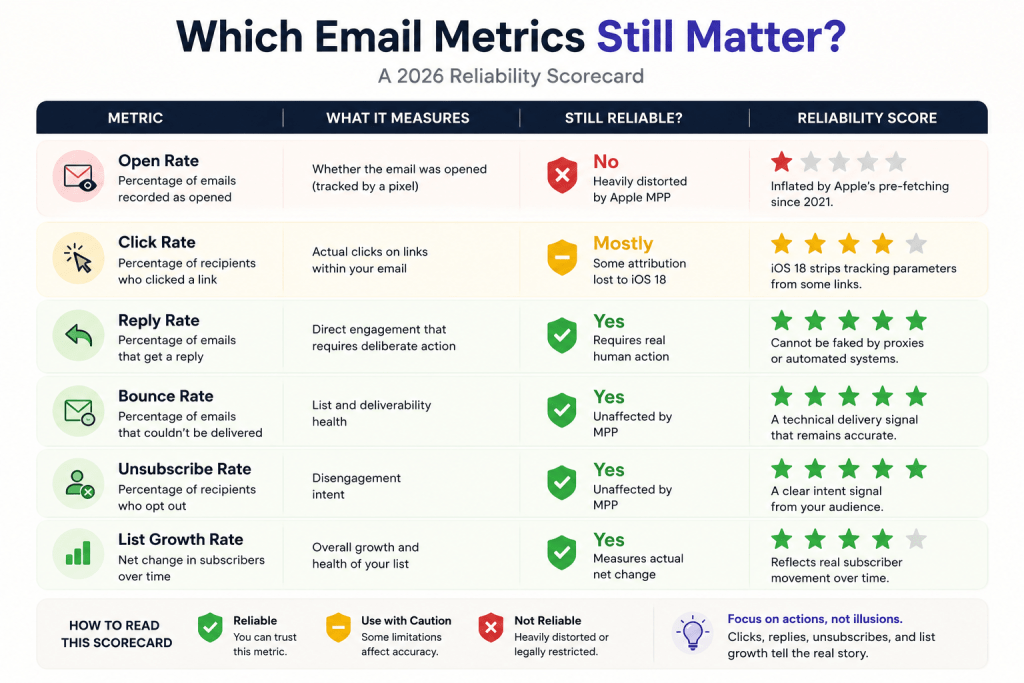
Here’s how the reliability of each signal actually breaks down now, not how it used to:
| Metric | Still Reliable? | What Changed |
|---|---|---|
| Open rate | No | Inflated by Apple’s pre-fetching since 2021 |
| Click rate | Mostly | Some attribution lost to iOS 18’s Link Tracking Protection |
| Unsubscribe rate | Yes | Unaffected by MPP |
| Bounce rate | Yes | Unaffected by MPP |
| Reply rate | Yes | Requires deliberate action, can’t be faked by a proxy |
| List growth rate | Yes | Measures actual net subscriber change |
Click Rate and Click-to-Open Rate
Clicking requires an actual decision. Apple’s pre-loading can fake an open, but it can’t fake a subscriber choosing to tap a link. Raw click rate, and click-to-open rate once you filter out the Apple Mail opens specifically, are the closest things left to a reliable read on whether people are engaging with what you send, not just whether their inbox provider fetched it. If your ESP lets you exclude Apple Mail opens from the CTOR calculation specifically, use that version. The unfiltered number still has some of the same distortion baked into its denominator.
For a rough benchmark to compare against, industry data from 2026 puts a healthy click-to-open rate above 10% and a raw click rate above 2.5% across most sectors, though a smaller, more targeted list tends to outperform those averages. A tighter list beats a bigger, mushier one every time.
List Growth Rate
How fast your list is actually growing, net of unsubscribes, tells you whether what you’re doing is working at the top of the funnel. It’s slower to respond than opens or clicks, so it won’t tell you much about a single send, but nothing about it can be faked by a mail client pre-fetching your images. Track it monthly, not per campaign. Day-to-day noise will drown out the trend that actually matters.
Unsubscribe and Complaint Rate
These stayed reliable through all of this, since MPP has no effect on bounce, unsubscribe, or spam complaint data. A rising complaint rate is still one of the clearest signals that something in your content or your sending cadence needs to change, and unlike open rate, there’s no privacy feature quietly inflating it in the background. If this number climbs, believe it.
Reply Rate
If your newsletter format allows for replies, and most personal or small-blog newsletters do, a reply is about as strong a signal of genuine engagement as you’ll get. It’s also the one metric here that most ESP dashboards don’t surface prominently, so you may need to check it manually against your actual inbox rather than a report. I started keeping a simple running count in a spreadsheet after realizing my ESP had no reply-tracking view at all. Five minutes a week. Worth it for a number nothing else gives you.
How I Sized My Own Apple Mail Exposure
Most email platforms expose a breakdown of opens by email client somewhere in their analytics, even if it’s not on the main dashboard. I pulled 90 days of data and segmented it by client type, which is what actually told me my Apple Mail share was around two-thirds of my list, higher than I would have guessed. That single number changes how much weight you should put on your headline open rate. A list that’s 10% Apple Mail has a mostly trustworthy open rate. A list that’s 65% Apple Mail, like mine, effectively doesn’t.
If your platform doesn’t surface a client breakdown directly, check whether it distinguishes between an open registered within a second or two of delivery versus one that happens minutes or hours later. Apple’s pre-fetch typically fires almost instantly on delivery, so a cluster of opens timestamped right at send time, especially ones with no corresponding click, is a reasonable proxy for MPP activity even without an explicit client label. It won’t be exact, but it’s enough to tell you whether you’re dealing with a small distortion or a large one.
What I Actually Stopped Doing Because of This
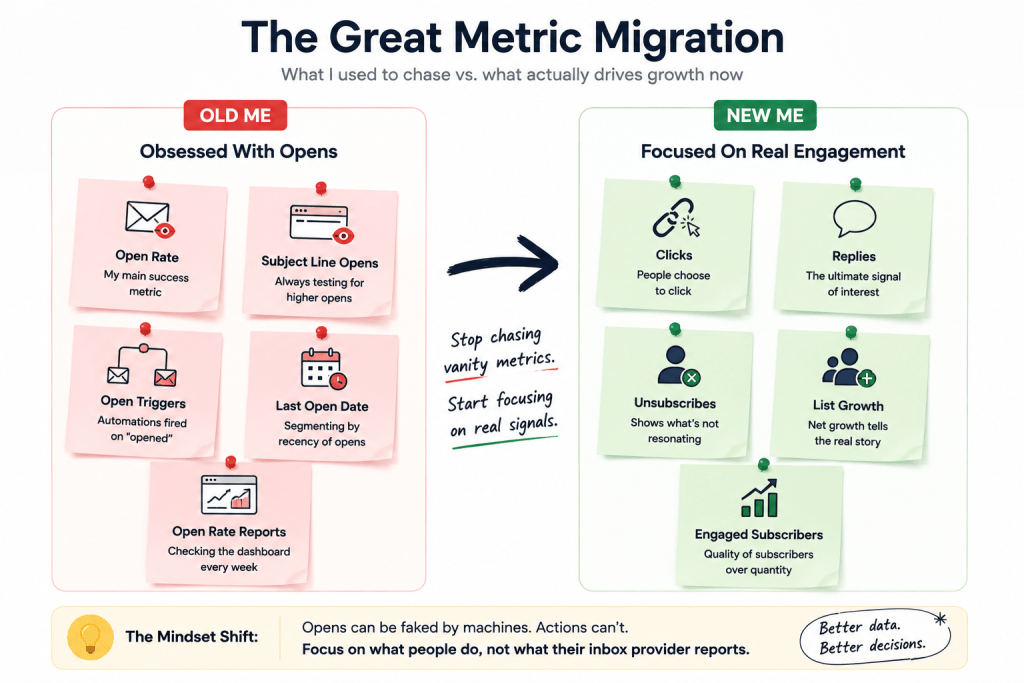
A few habits I dropped once I understood how much of my open data was noise:
→ Stopped running subject line A/B tests that measured success by open rate alone, since a winning variant might just mean it happened to reach more Apple Mail addresses, not that it was actually more compelling.
→ Stopped triggering any automation step off an “opened” event and rebuilt those triggers around clicks instead. That meant rethinking a couple of sequences I’d set up assuming opens were a meaningful signal of intent.
→ Stopped reporting a single headline open rate anywhere, to myself or anyone else, without also noting what share of the list is Apple Mail.
→ Stopped pruning subscribers based on last-open date. MPP means a completely dead Apple Mail subscriber shows a fresh “open” on every single send, forever, so open-date pruning fails to catch the subscribers actually worth removing. Switched to last-click or last-reply instead, since neither can be faked by a mail client pre-fetching your images.
Questions People Ask About Email Marketing Metrics
Is open rate completely useless now?
Not entirely. It still confirms an address is live and can catch obvious deliverability problems, but it’s no longer reliable as a measure of genuine reader engagement, especially on lists with significant Apple Mail usage.
How do I know how much Apple Mail is affecting my numbers?
Check your ESP’s open-by-client breakdown, if it offers one, over a recent 90-day window. That percentage tells you roughly how inflated your headline open rate likely is.
Should I stop tracking opens altogether?
No. Keep tracking them for list-health signals like bounces and basic activity, just stop treating the number as a success metric or using it to decide who to remove from your list.
What metric should I actually report to myself or a client?
Click-to-open rate, filtered for Apple Mail where your platform allows it, alongside list growth rate and unsubscribe rate. Together they give a much more honest picture than open rate alone.
Does this affect small lists differently than large ones?
Not in mechanism, but in visibility. A small list makes the distortion easier to spot, since a handful of instant, click-free opens stand out more clearly in 200 subscribers than in 20,000, where the same pattern gets buried in aggregate numbers.
Do I need consent to track email opens under GDPR?
For EU subscribers, individual-level open tracking now requires separate, explicit consent under CNIL’s April 2026 guidance, with Italy’s Garante and the UK’s PECR taking similar positions. Aggregated, non-identifying campaign totals fall outside that requirement. This is general information, not legal advice, so confirm your specific obligations with someone qualified.
Conclusion
Pull your own client breakdown before you trust your next open rate report. If Apple Mail makes up a meaningful share of your list, treat that open rate as a rough directional number at best, not a scorecard.
Shift whatever decisions you’re currently basing on opens, subject line tests, automation triggers, list pruning, over to clicks, replies, and unsubscribe data instead. If you haven’t already sorted out authenticated sending, start with deliverability first, since none of these metrics matter if your emails aren’t reaching the inbox in the first place.
If you send to EU subscribers, check whether your ESP has updated its pixel consent handling since April 2026. That’s a compliance question worth closing out separately from the data-quality one.
And if you’re running any of the automation tools I tested recently, go check what those triggers are actually keyed to before assuming they’re working the way you think they are.