

A client of mine spent four months on a platform built for companies doing $10 million a year. She was doing $400,000. The tool wasn’t bad. It was just wearing a suit two sizes too big, and she paid enterprise prices to feel small inside it.
That’s the mistake I see most often when a small business shops for affiliate or referral software. Not picking a bad tool. Picking the wrong-sized one.
Here’s how to actually make this decision, without a demo call talking you into more platform than you need.
What Kind of Small Business You Run Decides Which Affiliate Software Fits
Every affiliate and referral platform on the market was built with a specific business model in mind. Ignore that, and you’ll spend weeks fighting a tool that was never designed for your setup.
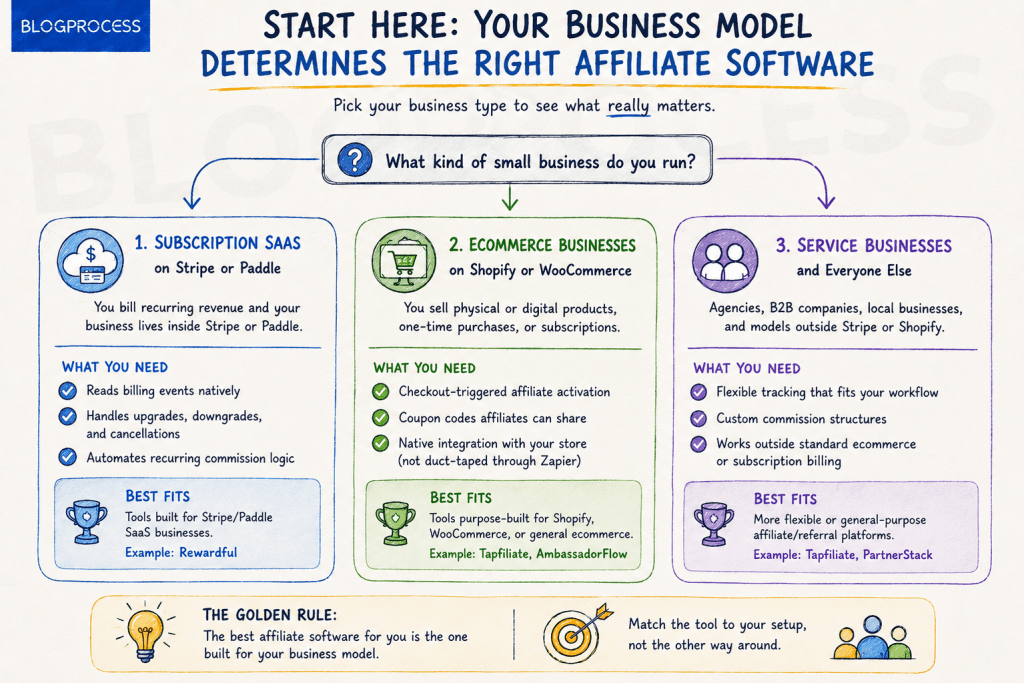
There are really three buckets.
Subscription SaaS Businesses on Stripe or Paddle
If you bill recurring revenue and your whole business lives inside Stripe, you want a platform that reads billing events natively, not one that bolts on afterward. Commission logic needs to handle upgrades, downgrades, and cancellations automatically, or someone on your team becomes a human spreadsheet.
Ecommerce Businesses on Shopify or WooCommerce
Physical or digital products, one-time purchases, maybe subscriptions layered on top. You care about checkout-triggered activation, coupon codes affiliates can hand out, and whether the platform actually installs into your store instead of duct-taping through Zapier.
Service Businesses and Everyone Else Affiliate Software Ignores
Agencies, local companies, B2B firms selling outside a Stripe-native or Shopify-native world. This is the group most affiliate software quietly ignores. Know that going in.
I’ve set this up for clients in all three buckets, and the single biggest predictor of a bad twelve months isn’t the platform’s feature list. It’s whether the business model matched what the tool was actually built for.
Affiliate Software Pricing Models: Which One Is Riskiest for a Small Business
This part gets glossed over constantly, and it’s the part that actually determines whether the tool pays for itself.
| Pricing Model | How It Works | Real Risk |
|---|---|---|
| Flat monthly fee | Same bill whether the program drives $0 or $50,000 | You’re paying rent on a program that hasn’t proven itself yet |
| Flat fee + revenue share | Base subscription plus 1 to 15% of affiliate-driven revenue | Costs climb exactly when the channel is working, which stings more than it should |
| Performance-only | $0 base, you pay a cut only on revenue the program actually generates | Lowest downside risk, but usually caps out in features once you scale |
| Custom enterprise quote | No published pricing, sales call required | Often signals the tool wasn’t built with your size of business in mind at all |
A tool with no public pricing page is telling you something before you even talk to sales. It usually means the platform is priced around your revenue, not your feature needs, and that math rarely favors a company still finding its footing. I’ve watched a client get quoted three different numbers for the same feature set in one week. That’s not a coincidence.

Affiliate and Referral Platforms for Small Businesses Compared
I pulled current numbers on five platforms that keep coming up when small businesses ask me this question. Treat this as a starting map, not a leaderboard. None of these is “the best.” Each solves a different version of the problem.
| Platform | Built For | Starting Cost | The Catch |
|---|---|---|---|
| Rewardful | Stripe or Paddle SaaS | $49/mo | Locked to those two processors, revenue-capped tiers |
| Tapfiliate | Shopify, WooCommerce, general ecommerce | $89/mo ($74/mo billed annually) | Flat fee is honest, but clicks and conversions meter on higher tiers |
| AmbassadorFlow | Customer-to-referrer programs on Shopify/WooCommerce | $0/mo (10% of new revenue) or $99+/mo flat | Referral-focused, not built for recruiting outside affiliates |
| Superfiliate | Shopify creator and affiliate programs | No public pricing. Third-party estimates put it around $299 to $399/mo, plus a success fee | Shopify only, no WooCommerce, priced for creator-heavy programs |
| PartnerStack | B2B SaaS partner ecosystems | Custom quote, typically $500 to $2,500+/mo | Genuinely overbuilt for anything under roughly $1M ARR |
The table narrows the field, but the right choice still depends on your business model, budget, and how much complexity you actually need.

Tapfiliate for Small Businesses Testing Their First Affiliate Program
Tapfiliate sits in the gap almost nobody talks about: too much tool for a DIY spreadsheet, not enough spend to justify enterprise software. Flat pricing with zero cut of your revenue is rare, and for a business still validating whether affiliates even work for them, that predictability matters more than a longer feature list.
AmbassadorFlow for Small Businesses That Want to Pay Only on Results
AmbassadorFlow’s performance-only tier is the one I point cash-strapped clients toward first. Paying nothing until the program produces revenue removes the “did this even work” argument entirely, since a program that isn’t working also isn’t costing you anything beyond setup time.
Questions to Ask Before You Choose Affiliate Software
Skip the feature checklist. Ask these instead.
- Does it read my billing or checkout events natively, or does someone have to babysit a Zapier connection? Native beats bolted-on every single time, and the failure mode of a broken Zap is silent underpayment to your best partners.
- Am I recruiting outside affiliates, or turning existing customers into referrers? These are different jobs wearing similar marketing copy. A tool built for one does the other poorly.
- What happens to my data if I switch platforms in a year? Ask this before signing, not after you’ve outgrown the tool. Export friction is how vendors quietly lock you in.
- How does the platform pay affiliates, and what does that cost per payout? Some tools charge $3 to $5 per manual payout on top of the subscription. Run 40 affiliates through that monthly and it adds up fast.
- Is fraud detection built in, or bolted on as an add-on? Self-referrals and fake first-purchase attribution quietly drain reward budgets on any program that doesn’t check for them from day one.
- Does the pricing model reward the vendor when the program fails? A flat fee gets paid whether your affiliates sell anything or not. That’s not automatically bad, but know which incentive structure you’re signing up for.
When a Full Superfiliate Review Is Worth Reading Before You Choose
Some of these tools solve a narrow enough problem that a table is genuinely all you need. Others deserve real time in the product before you commit a client’s budget to them.
Superfiliate is one of the ones worth going deeper on, specifically because its pricing and positioning target a fairly specific business: Shopify brands treating creators as a growth channel, not just a link-tracking chore. If that’s not your setup, the table above tells you everything you need. If it might be, I ran it for 90 days and wrote up what actually happened, including the parts the pricing page doesn’t mention.
That’s the pattern worth repeating for any tool on this list before you sign an annual contract. A comparison table narrows your options. It shouldn’t be the only research you do before money changes hands.
Common Mistakes Small Businesses Make Choosing Affiliate Software
A few patterns show up over and over with small business owners making this call for the first time. I’ve watched all four play out with real budgets on the line.
Buying the enterprise tool because it sounds more serious. A custom quote and a sales call don’t mean better software. They usually mean pricing scaled to a business bigger than yours.
Ignoring the payout mechanics until affiliates start complaining. How partners actually get paid, and how often, is a bigger driver of program health than almost any dashboard feature.
Choosing based on the demo instead of the trial. A sales demo shows you the best-case click path. A free trial shows you what setup actually feels like on a Tuesday when something doesn’t sync right.
Assuming referral and affiliate are the same problem. They’re not. One recruits new promoters from outside your customer base. The other activates people who already bought from you. Pick software built for the job you actually have.
Frequently Asked Questions About Affiliate and Referral Softwares
Do I need a written agreement with my affiliates, or is a signup form enough?
Get something in writing, even a short one. At minimum it should cover the commission rate, when payouts happen, what counts as a valid sale, including whether a refund claws back the commission, and a line requiring affiliates to disclose the relationship per FTC guidelines when they promote you. Most platforms bundle a basic terms-of-service step into affiliate signup, but read what’s actually in there before launch. A generic template pulled from the platform’s default settings often doesn’t match your refund policy or commission structure.
What commission rate should I actually offer?
For ecommerce, 10 to 20% of the sale is the common range, higher on digital products where margins are wider, lower on physical goods with real cost of goods sold. For subscription SaaS, a 20 to 30% recurring commission on the first few months, or a smaller lifetime percentage, is typical. The number matters less than consistency. I’ve seen programs fall apart over this exact issue. Affiliates compare notes, and a rate that changes program to program or partner to partner erodes trust fast.
Can I run an affiliate program manually, without software, before I commit to a platform?
Yes, and I’d actually recommend it if you’re not sure the channel will work for your business. A spreadsheet, unique coupon codes, and manual monthly payouts through PayPal or bank transfer can validate demand with five to ten affiliates. The moment tracking errors start costing you real money, or you’re spending more than an hour a week reconciling who gets paid what, that’s the signal to move to software, the same tipping point behind most of the manual admin work that quietly eats a founder’s week until it finally gets automated. Don’t buy the platform before you have evidence you need it.
How long before an affiliate or referral program actually produces revenue?
Budget three to six months before you have enough data to judge whether it’s working, not before you see your first sale. The first month is almost always recruitment and onboarding. Nobody sells anything yet. Real signal shows up once a handful of affiliates have had time to actually promote you, which for most small businesses means the second or third billing cycle at minimum. Judging the channel at 30 days is the single fastest way to kill a program that just needed more runway.
Will an affiliate platform work with the email tool or CRM I already use?
Check this before you sign, not after. Most of the platforms above integrate with Klaviyo, Mailchimp, and the major CRMs through either native connections or Zapier, but the depth varies a lot. Native integrations sync affiliate status and purchase data automatically. Zapier-based ones usually work but add a point of failure that’s easy to miss until a sync silently stops. If you’re running HubSpot, I’d check what its connectors can and can’t actually do before assuming an affiliate tool will slot in cleanly. If your business runs on a less common stack, ask for a list of native integrations before the trial, not during it.
What happens to my affiliates if I switch platforms later?
This is the question most small businesses forget to ask until it’s too late. Affiliate relationships, tracking links, and payout history don’t automatically transfer between platforms. Migrating usually means re-inviting every affiliate to a new dashboard and reissuing their tracking links, which resets any SEO or backlink value those links were carrying and briefly breaks attribution during the switch. It’s not a reason to avoid switching if a platform genuinely isn’t working, but it’s real friction worth weighing before you sign a year-long contract with an unproven tool.
Conclusion
Figure out which of the three business-model buckets you’re in before you look at a single pricing page. That single decision eliminates more than half the market instantly and saves you from sitting through demos for tools that were never going to fit.
Then pick pricing risk over feature count. A $0-base performance plan or a flat $89/month tool you can cancel next quarter beats a custom enterprise quote you’re locked into for a year, especially if this is your first real affiliate or referral push.
Start a trial on whichever tool matches your bucket, run one real payout cycle through it, and only then decide if you need something more advanced. You’ll know more from that one cycle than from another week of comparison articles, including this one.