I almost didn’t bother reviewing Superfiliate. Another “all-in-one creator platform” claiming to fix the mess of affiliate tools, influencer spreadsheets, and gifting chaos? Sure, buddy.
Then I set it up on a supplements brand client’s Shopify store, ran it for three months, and watched a cobranded landing page outperform a plain discount code by a margin I wasn’t expecting. That changed my mind.
This is what happened when I actually used Superfiliate, not a feature list copied from their homepage.
Quick answer: Superfiliate is a Shopify-only platform that unifies affiliate tracking, influencer gifting, and Meta Partnership Ads into one dashboard. Pricing runs “à la carte. a month plus a success fee, and it’s best suited to D2C brands already generating creator-driven revenue, not stores starting their first affiliate program from zero.
What Is Superfiliate? The Shopify Creator-Led Growth Platform Explained
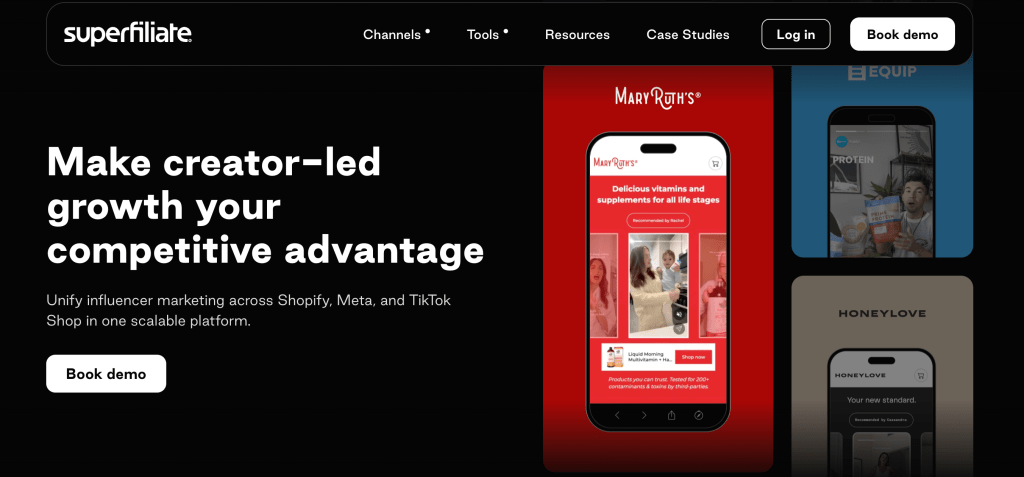
Strip away the marketing copy and Superfiliate does one specific job. It takes every creator relationship a Shopify brand has, affiliates, ambassadors, paid influencers, and puts them in one system instead of three.
Most stores I’ve consulted for run this setup: an affiliate tool for tracking, a separate influencer agency for outreach, and a paid media team running Meta ads that has zero visibility into what creator content is actually converting. Nobody talks to each other. Reporting never matches.
Superfiliate’s pitch is that this fragmentation, not creator quality, is what kills programs. I happen to agree, mostly because I’ve watched it happen firsthand on client accounts that were bleeding budget on three disconnected vendors. It’s the same root problem we’ve flagged before in why most affiliate marketers never get past the basics: the failure is rarely the model, it’s the execution around it.
Here’s what stood out after three months of actually running it:
- Cobranded landing pages convert better than bare discount codes, because the page feels owned by the creator instead of slapped together
- Gifting automation removes the spreadsheet entirely, no manual order entry, no chasing shipping addresses
- Meta Partnership Ads launch from inside the platform, cutting out the whitelisting back-and-forth that normally eats days
- Payouts and tax filing run on autopilot across PayPal, ACH, Venmo, and store credit
The platform is built around three modules you can activate independently:
- Shopify Influencer Hub: the core. Cobranded landing pages, gifting, payouts, and a UGC library
- Meta Ads Suite: turns creator content into Partnership Ads with one-click authentication
- TikTok Shop: creator discovery and collaboration management for TikTok-driven sales

You don’t have to turn on all three at once. I started with just the Influencer Hub and added Meta later, which honestly is the right way to test it before committing to the full stack.
Inside the Setup: Connecting Superfiliate to a Real Shopify Store
Store Connection and the First Cobranded Landing Page
Connecting their Shopify store took about four minutes. Product data, brand colors, fonts, all of it pulled in automatically. No CSV exports, no manual mapping. That part genuinely impressed me, because I’ve set up affiliate tools where this step alone ate an entire afternoon. It’s part of why Shopify remains our top ecommerce pick for clients who want their tech stack to actually talk to each other.
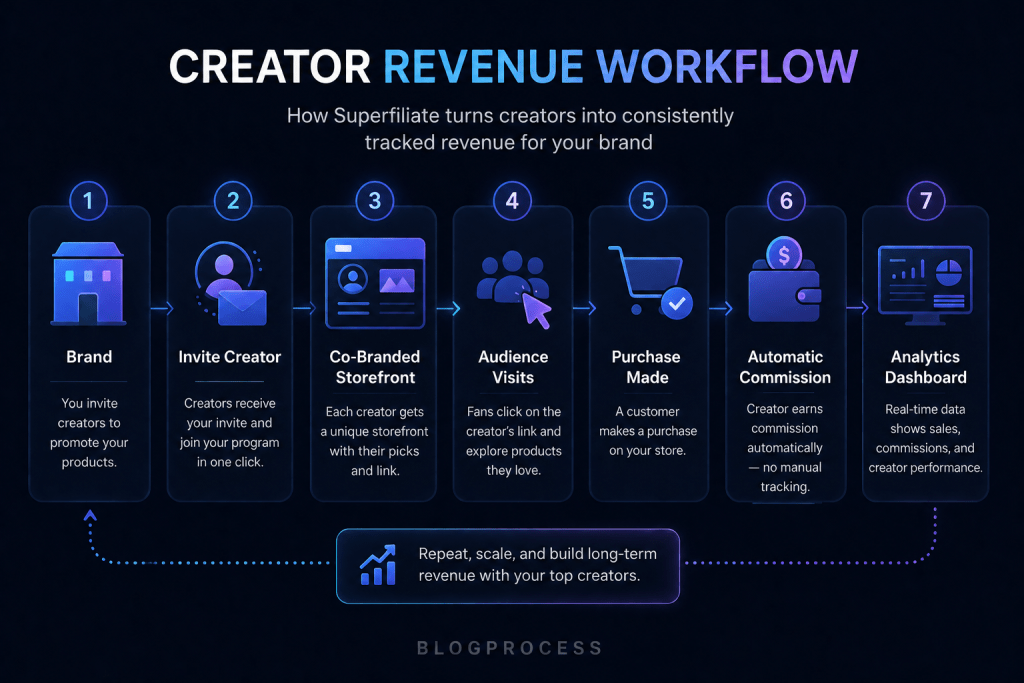
Building the first cobranded landing page took longer than I expected, mostly because I kept tweaking the layout instead of shipping it. Once I stopped fussing, a page was live in under fifteen minutes. Each creator gets their own URL with curated product picks, their bio, and embedded social proof. It feels like their page, not a slapped-together affiliate link with “USE CODE SARAH15” pasted on top.
Gifting Automation and Payouts in Practice
Here’s the thing nobody tells you upfront. Gifting automation is the feature that actually saves time, not the landing pages. I sent a batch invite to twelve creators, they each picked a product, and Superfiliate triggered the Shopify orders automatically. No spreadsheet. No me manually entering shipping addresses at 11pm.
Payouts worked the same way. Commission and flat-rate options through PayPal, ACH, Venmo, and store credit, with tax filing handled in the background. If you’re deciding between commission-based and flat-rate payout structures for your own program, Superfiliate lets you mix both rather than locking you into one model. I tested a PayPal payout to a creator and it landed within a day.
Superfiliate’s Meta Ads Suite: The Feature That Sets It Apart
This is the part that separates Superfiliate from a basic affiliate tracker, and it’s the reason I’d actually recommend it over cheaper alternatives if paid social matters to your brand.
One-Click Creator Authentication for Partnership Ads
Traditional Meta Partnership Ads setup means whitelisting, authentication codes, and a back-and-forth with creators that can drag on for days. I’ve lived through this pain on client accounts. Superfiliate compresses it into a single link a creator taps to approve ad access.
Turning Organic Winners Into Paid Campaigns
Once approved, you can launch the campaign without leaving the platform. I took a piece of organic content that was already performing (decent engagement, real comments, not bot noise) and pushed it into paid through the Meta suite directly. No exporting creative, no re-uploading to Ads Manager, no waiting on a separate agency to “find time this week.”
The performance dashboard reports ROAS, CTR, and purchases tied back to that specific creator. That’s the loop the whole platform is built around: organic proves the winner, paid amplifies it, and the data tells you which creator to scale next.
It’s not flashy. It’s just fewer steps between “this is working” and “let’s put budget behind it.”
Superfiliate Pricing in 2026: Plans, Fees, and Hidden Costs
Superfiliate doesn’t publish pricing, which annoys me every time a vendor does this. Based on what I’ve seen across billing data and current users, here’s the real picture. Pricing below is verified as of mid-2026; demo-gated pricing shifts more often than published plans, so confirm current numbers on your call.
Monthly Subscription Tiers
Entry-level access, billed directly through your Shopify invoice. Higher tiers, the ones that unlock the Meta Ads Suite and advanced analytics, climb toward thousands a month depending on program size and which channels you activate.
The Success Fee and Getting a Real Quote
On top of the subscription, there’s a success fee. Shopify automatically collects a percentage of net revenue whenever an approved conversion happens through your Referral or Creators programs. You can see your specific rate inside Settings > Pricing Plans once you’re in. There’s no public trial. You go through a demo call first, though sandbox access is available for some use cases.
Is that expensive? Compared to a free tool like Shopify Collabs, obviously. Compared to enterprise platforms like Impact.com or GRIN, it’s a relative bargain. Context matters here, which is exactly why I built the comparison below. We hit a similar demo-gated pricing pattern when testing Deel across four of its products: the headline number is rarely the real number, and you only find out once you’re inside the sales process.
Superfiliate vs Social Snowball vs Shopify Collabs vs Impact.com
Affiliate marketers love asking me “but how does it compare to X” before they’ll even consider a tool. Fair question. Here’s the honest breakdown based on current pricing and feature scope for each platform.
| Platform | Starting Price | Best For | Biggest Limitation |
|---|---|---|---|
| Superfiliate | A la carte + success fee | Brands running affiliate, influencer, and paid amplification together | Shopify-only, demo-gated pricing |
| Social Snowball | $249 to 899/mo + 3% on lower tier | Fast customer-to-affiliate automation | No cobranded landing pages |
| Shopify Collabs | Free + 2.9% payout fee | Brands just starting an inbound affiliate program | Weak CRM, mixed creator quality in the open network |
| Impact.com | $30 to 2,500+/mo + 2.5% network tax | Enterprise multi-partner programs across markets | Heavy setup, often 3 to 6 month deployment |
A few things stand out once you sit with this table. Shopify Collabs costs nothing upfront, and for a brand testing the waters, that’s genuinely the right starting point. I’d never tell a five-figure-revenue store to skip straight to Superfiliate. But Collabs has no real CRM and the open creator network attracts what one reviewer bluntly called SEO scrapers gaming your discount codes.
Social Snowball automates the “customer becomes affiliate” flow better than anything else on this list. If your whole strategy is turning repeat buyers into casual promoters, it does that job well and cheaply at the entry tier. What it doesn’t do is build a real landing page experience for creators, and it doesn’t touch paid amplification at all.
Impact.com is the heavyweight. If you’re running thousands of partners across twenty countries, it has depth nothing here matches. For a mid-size D2C brand, though, that depth becomes dead weight. Multiple sources I checked report three to six month implementation timelines just to get tracking pixels and CRM pipelines fully wired up. That’s a long runway for a brand that wants results this quarter.
Superfiliate sits in the gap between “too basic” and “too enterprise.” It’s the only one on this list built natively around Meta Partnership Ads, and that single feature justified the price tag for me once I saw it in action.
If the comparison above already tells you which lane you’re in, no reason to wait until the end of this post. Check current Superfiliate plans here and book the demo while the comparison is still fresh in your head.
The Honest Drawbacks: Where Superfiliate Falls Short
I don’t write one-sided reviews, and Superfiliate isn’t perfect.
Shopify-only is a real wall. If you’re on WooCommerce or a custom build, you’re locked out completely right now. That’s not a minor footnote, it’s a dealbreaker for a meaningful chunk of brands reading this. If you’re already weighing Shopify against other ecommerce platforms, factor Superfiliate into that decision before you commit, switching platforms later just to unlock a creator tool is a bad reason to migrate.
Pricing opacity gets old fast. I get why demo-based pricing exists at this tier, but spending forty-five minutes on a sales call just to learn a starting number is friction that competitors with public pricing pages don’t impose.
It’s overkill if all you need is a link tracker. Three of my clients tested Superfiliate and two of them didn’t need half the platform. If your program is small and commission-only with zero interest in gifting or paid amplification, you’re paying for capability you won’t touch.
Setup takes longer than the marketing implies for the advanced stuff. The Shopify connection is instant. Getting the Meta Ads Suite, automations, and social listening dialed in properly took me closer to two weeks of actual hands-on work, not the “minutes” some review sites promise.
None of these killed the experience for me. They’re just the honest edges of the product.
Is Superfiliate Right for Your Shopify Store?
After running it for ninety days, here’s my real take on fit.
Superfiliate makes sense if you’re a Shopify D2C brand already running an affiliate or ambassador program and feeling the ceiling. Too many manual touches, reporting that doesn’t add up, agencies that don’t talk to each other. It’s also a strong pick if creator content is feeding your paid social strategy, since the Meta integration alone can replace a chunk of agency overhead.
It’s the wrong tool if you’re under $500K in annual revenue with no influencer strategy yet, or if you’re not on Shopify at all. In those cases, start with Shopify Collabs for free, prove the channel works, and graduate to something like Superfiliate once you’ve outgrown spreadsheets. If WooCommerce or a leaner budget describes your situation better, I broke down the small business options that actually fit that stage instead of pushing everyone toward the same platform.
Frequently Asked Questions
Does Superfiliate integrate with Klaviyo and other marketing tools?
Yes. It connects with Klaviyo and KnoCommerce directly, and supports email and SMS automation so creator activity feeds into the same flows you’re already running. If your email marketing stack is already built around one of those platforms, the integration is closer to plug-and-play than a rebuild. Creator revenue also pushes into your analytics stack instead of sitting in a separate dashboard nobody checks.
Is onboarding self-serve, or does Superfiliate provide hands-on setup help?
It’s hands-on. Every account I’ve touched, including the client store this review is based on, went through an actual onboarding conversation rather than a “watch this video and figure it out” experience. That’s part of why the demo-gated pricing exists in the first place.
Can Superfiliate run alongside an existing influencer agency, or does it replace one?
Both, depending on what the agency does. If the agency is purely managing outreach and content, Superfiliate becomes the system of record they plug into. If the agency is also running your paid amplification separately, the Meta Ads Suite tends to absorb that work over time, since it’s already pulling the same creator data.
What types of Shopify brands get the most value from Superfiliate?
In practice, the brands that lean hardest on visual, story-driven products: beauty, wellness, supplements, food and beverage, apparel. Anything where a creator’s personal taste actually moves a buying decision benefits more from cobranded landing pages than a brand selling commoditized goods on price alone.
Is there a minimum revenue requirement to use Superfiliate?
Nothing published. But the pricing structure, a flat subscription plus a success fee on top, tells you who it’s built for. It assumes you already have creator-driven revenue flowing and want to formalize it, not a pre-revenue store testing whether affiliate marketing works at all.
Conclusion
If creators are already driving a meaningful slice of your revenue and you’re tired of three tools that don’t agree with each other, this is worth the demo call. Connect your Shopify store, pull up your last ninety days of affiliate revenue, and walk into that call with real numbers instead of guesses. It changes the pricing conversation.
I used Superfiliate directly and recommend it for exactly this use case: D2C brands ready to move past spreadsheet chaos. Check current Superfiliate plans here and book the demo before you scale your next campaign manually.