Picture a customer typing this into an AI assistant: “Find me a good office chair under $300 that can be delivered this week.” A few months ago, that query got ten blue links and a headache. Now the AI can search participating stores, compare products, check what’s actually in stock, and put something in a cart. No tabs. No bouncing between five sites. Just an answer.
This isn’t a thought experiment anymore. It’s live. And the technology making it possible has a name your small business needs to understand, even if you never touch a line of code because of it.
What Is the Universal Commerce Protocol (UCP)?
The Universal Commerce Protocol, or UCP, is a common language that lets an AI assistant talk to a store. That’s it. Forget the API documentation for a second.
Before UCP, every AI platform needed its own custom connection to every retailer. Messy. Expensive. It didn’t scale, the same way the internet couldn’t have scaled if every device needed a private handshake with every other device.
Google and Shopify built UCP to fix that, launching it publicly in January 2026 at the National Retail Federation conference. Etsy, Wayfair, Target, and Walmart signed on as early partners, and more than 20 additional companies backed it, including Visa, Mastercard, Stripe, and American Express. It’s already wired into Google AI Mode, the Gemini app, and Microsoft Copilot Checkout.
This is the same headache that trips up Google Merchant Center feeds all the time, usually something dumb like a mismatched GTIN or a stale price, the exact kind of issue our guide to fixing WooCommerce product schema walks through at the source. UCP takes that same underlying idea, your product data has to be clean and current, and extends it into a live conversation between an AI agent and your store’s backend. Same problem, higher stakes.
Why Small Businesses Should Care About AI Shopping Agents
Here’s the question that actually matters: can AI understand your business well enough to recommend it?
Not “will AI replace shopping.” Not “is this the end of ecommerce as we know it.” Just that one question. Because customers are starting to ask AI instead of Google when they want to find something specific.
Think about the last time you let an AI assistant boil down a topic instead of reading five articles yourself. Shopping is heading the same direction. The businesses that show up in that conversation get considered. The ones that don’t, don’t.
This matters more for small businesses than big ones, not less. A large retailer has an army of people keeping product data clean. You might have you, a spreadsheet, and whatever your plugin auto-generates. That gap is exactly where this gets interesting, and I’ll get to why later in this piece.
What AI Shopping Agents Could Do for Your Customers
Abstract protocols are boring. Real scenarios aren’t. Here’s what this looks like across different small business types.

A clothing store → a customer asks, “Find me a linen shirt under $80 in medium.” The agent needs to know your sizing, your price, and whether medium is actually in stock today, not last Tuesday.
A furniture store → “Find a desk that fits a 120 cm space.” Dimensions matter here more than almost anywhere else. If your product page doesn’t list exact measurements, the agent skips you.
A beauty store → “Find a skincare product for dry skin under $40.” Skin type, price, and ingredient claims all need to be structured data, not buried in a paragraph of marketing copy.
A local business → “Find a florist that can deliver roses tomorrow.” This one depends entirely on accurate local inventory and delivery windows being visible to the agent in real time.
Notice what all four have in common. None of them mention UCP. None of them care about the protocol name. They just want an answer that’s actually correct.
How UCP Works Behind the Scenes
Only now, after four real examples, does the technical flow actually make sense.
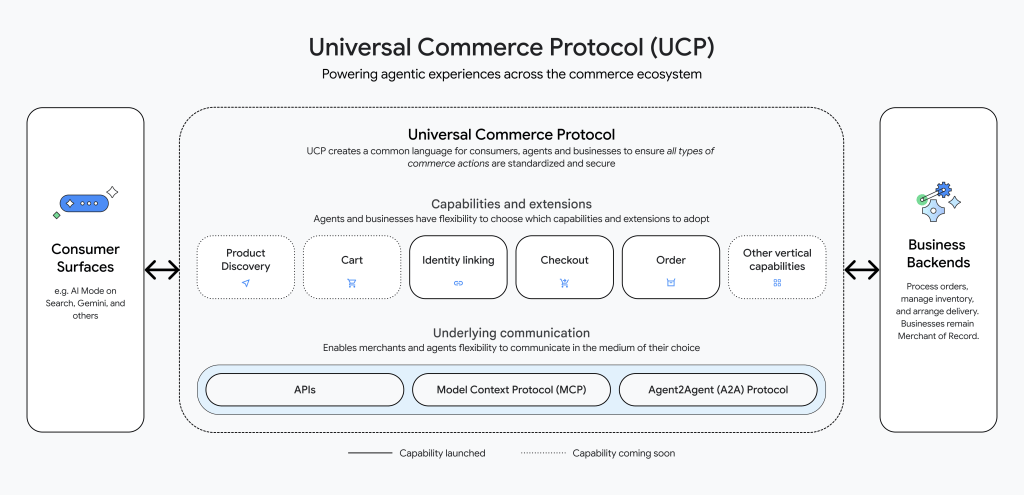
The path looks roughly like this: customer asks an AI agent → the agent uses UCP to query participating business systems → the business system responds with product, cart, and checkout data → the agent completes the transaction or hands it back to the customer to confirm.
UCP breaks this into stages. Google’s own engineering team describes four operational pieces: product discovery, capability negotiation, checkout, and post-purchase handoff. Each stage is its own layer, which means a small store can support product discovery today without building full checkout tomorrow. Nobody’s forcing an all-or-nothing rollout.
That layered design matters. It means you don’t need to boil the ocean. You can start small, and honestly, you probably should.
What UCP Means for Your Website and Product Data
A beautiful website isn’t enough anymore. It never really was for SEO either, if we’re honest.
Your product information now needs to be accurate, structured, accessible, and current, all four, all the time. An AI agent can’t infer that your “one size fits most” hoodie actually runs small. It can’t guess that your “in stock” badge hasn’t been updated since March. It reads what’s there.
Stale product feeds are one of the most common issues in small ecommerce stores, items marked in stock long after they’ve been discontinued, sizes that never got updated. Nobody notices because humans skim. Agents don’t skim. They act on exactly what the data says, which means bad data doesn’t just cost you a sale anymore. It costs you the recommendation entirely.
Structured data is what actually carries that information to an agent. If your product pages don’t already have proper schema markup set up, our AIOSEO features breakdown walks through the plugin most WordPress stores use to handle it without touching code.
UCP vs ACP: The Other AI Shopping Protocol to Know
UCP isn’t the only game in town, and pretending otherwise would do you a disservice.
OpenAI has its own standard called the Agentic Commerce Protocol, or ACP, live inside ChatGPT since September 2025. It works with Stripe on the payment side and charges merchants a transaction fee on completed purchases. Different company, different mechanics, same underlying goal: let an AI agent buy something on a customer’s behalf.
| Protocol | Built By | Live On | Payment Model |
|---|---|---|---|
| UCP | Google & Shopify | Google AI Mode, Gemini, Copilot Checkout | Google Pay, PayPal coming |
| ACP | OpenAI & Stripe | ChatGPT | Stripe, ~4% transaction fee |
Most ecommerce brands won’t get to pick one and ignore the other. Customers who live in ChatGPT and customers who live in Gemini are both real customers. Betting your entire strategy on a single protocol is a rookie move, even if UCP currently has the bigger coalition behind it.
Small Business Checklist for AI Shopping Agents
Before you worry about UCP itself, worry about this list. It’s the foundation everything else sits on.
| Task | Why It Matters | Effort Level |
|---|---|---|
| Accurate, current pricing | Agents act on the price shown, not the price you meant to update | Low |
| Real-time inventory accuracy | A recommended out-of-stock item kills trust instantly | Medium |
| Complete product variants | Size, color, and material need to be structured, not implied | Medium |
| Clear shipping information | “Ships fast” isn’t data an agent can use | Low |
| Clear return policies | Agents increasingly factor this into recommendations | Low |
| Structured product data | Schema markup is how machines actually read your pages | Medium |
| Google Merchant Center accuracy | It’s becoming the source of truth for agentic discovery, not just shopping ads | Medium |
| Technically healthy website | Broken checkout flows and slow pages hurt agent trust the same way they hurt humans | High |
| Consistent info across platforms | Your site, your feed, and your socials all need to agree with each other | Medium |
Nine items. Not five, not ten. Just the nine things that actually move the needle right now.
Do You Need to Implement UCP Yourself Today?
Short answer: probably not. And I don’t say that to let you off the hook.
There’s a real difference between “prepare for AI commerce” and “implement UCP yourself.” They get treated as the same thing constantly, and it’s causing a lot of unnecessary panic among small business owners who don’t have a developer on staff.
Preparing means fixing your data. It means the checklist above. Implementing UCP means integrating with the actual protocol, which right now is rolling out gradually and working most smoothly with platforms like Shopify that are building native support directly into the ecosystem. If you’re on WooCommerce, native UCP integrations are expected as the protocol matures, but they’re not universally available yet.
So no, you don’t need to hire a developer this week. You do need to stop treating your product feed like an afterthought.
None of this works on a slow or unreliable host either. If your site’s technical foundation is shaky, start there. Our 2026 guide to choosing a web hosting provider covers what actually matters for a store that needs to stay fast and available around the clock.
SEO Isn’t Dying, It’s Adding a Layer
This is the part people get wrong the most, so let’s be precise about it.
Search ranking isn’t going away. But discovery is evolving, and the shift looks something like this: search ranking used to be the whole game, and now AI recommendation is becoming a second, parallel game running alongside it.
That means the businesses winning in five years will be optimizing for two audiences at once. Humans clicking through Google results, and AI agents evaluating structured data to decide who gets recommended in a conversation. Same underlying discipline, honestly. Clean data, clear information, technical health. It’s just that now a machine is reading it in real time instead of a crawler indexing it once a week.

That same consistency needs to carry over into how you talk to customers directly. Our best email automation and multichannel marketing tools guide covers keeping your messaging and offers aligned across every channel, which matters just as much to an AI agent cross-checking your claims as it does to a human subscriber.
The Small Business Advantage in Agentic Commerce
Here’s the optimistic part, and it’s not just cheerleading. It’s genuinely how this is playing out.
Large retailers have resources. Big teams, big budgets, big legacy systems that are honestly kind of a mess most of the time. Small businesses have something they don’t: speed.
A small store that maintains clean product data and a technically healthy website can be easier for an AI agent to understand than a massive retailer juggling millions of SKUs across a dozen legacy systems. Data quality is the great equalizer here, not integration budget. That’s not marketing spin. It’s how the agents are actually built to evaluate merchants right now.
You don’t need to become an AI expert. You need to make your business easy for AI to understand. That’s the whole game.
Questions People Ask About AI Shopping Agents and UCP
What is the Universal Commerce Protocol (UCP)? UCP is an open standard, built by Google and Shopify with partners including Etsy, Wayfair, Target, and Walmart, that lets AI agents discover products, check availability, and complete checkout directly with a merchant. It launched in January 2026 and already runs inside Google AI Mode, the Gemini app, and Microsoft Copilot Checkout.
Do small businesses need to implement UCP right now? No. Focus on accurate, structured, current product data first. UCP integration matters more once that foundation is solid, and adoption is rolling out gradually through 2026 rather than being required immediately.
How is UCP different from OpenAI’s Agentic Commerce Protocol? UCP is Google and Shopify’s protocol. OpenAI’s Agentic Commerce Protocol, or ACP, has been live in ChatGPT since September 2025 and runs on a transaction fee model through Stripe. Most brands will eventually need both rather than picking just one.
What should I do first to prepare my store for AI shopping agents? Start with your product data. Keep prices and inventory current, fill in complete variants, clarify shipping and return policies, and keep your Google Merchant Center feed accurate.
Does UCP replace SEO for ecommerce businesses? No. SEO still matters for traditional search visibility. UCP adds a second discovery layer where agents evaluate and recommend based on data quality. You need both.
Which platforms currently support UCP? Google AI Mode, the Gemini app, and Microsoft Copilot Checkout, with retailers like Target, Walmart, Etsy, Wayfair, and Shopify merchants participating. Rollout started in the US, expanding to Canada, Australia, and the UK by the end of 2026.
Conclusion
You don’t need to become an AI expert, and you definitely don’t need to panic-hire a developer this month. What you need is boring, unglamorous, and completely within reach: accurate prices, real inventory numbers, complete product details, clear policies, and a website that actually works.
Do that first. UCP and whatever comes after it will still be there once your data is clean, and you’ll be in a far better position to act on it than the store that spent the same six months worrying instead of fixing its feed.