

Here’s the short answer before the full breakdown: Deel is the stronger platform for most growing companies in 2026. Remote.com is the better call when legal structure and compliance certainty matter more than feature breadth, particularly if your workforce leans heavily on international contractors, or you’re in a regulated industry where the question of who legally employs your people needs a clean, unambiguous answer.
Neither platform is a bad choice. But one of them will cost you more than you expected, in hidden fees, capability gaps, or procurement friction, depending on how your company actually hires. What follows is based on both platforms’ pricing documentation, entity model disclosures, G2 and Capterra review data from 2025–2026, funding records, and the litigation that most comparison pieces mention once and move on from. Let’s not do that.
1. At a Glance: The Numbers That Define Both Platforms
| Dimension | Deel | Remote.com |
|---|---|---|
| Founded | 2019, San Francisco | 2019, Amsterdam |
| Latest Valuation | $17.3B, Series E, Oct 2025 | $3B, Series C, Apr 2022 |
| Total Funding Raised | ~$1.3B | ~$506M |
| Annualized Revenue | ~$1.4B ARR (Mar 2026) | ~$600M (estimated) |
| EOR Country Coverage | 150+ countries | 85–100+ EOR countries |
| EOR Price (Annual Billing) | $599/employee/month | $599/employee/month |
| Contractor Management | $49/contractor/month | $29/contractor/month |
| G2 Rating | 4.8 / 5 | 4.6 / 5 |
| Entity Model | Owned + third-party partners | 100% owned entities |
| Security Certifications | SOC 1, SOC 2, SOC 3, ISO 27001, GDPR | SOC 2 Type 2, ISO 27001, GDPR |
| Active Litigation | Rippling RICO civil case + DOJ criminal grand jury investigation (unresolved, May 2026) | None disclosed |
Sources: BusinessWire Oct 2025 · Crunchbase Oct 2025 · Tracxn · WhichPayroll Apr 2026 · Deel Security · Remote Trust Center

2. Pricing: The Number That Looks the Same Until It Doesn’t
Both platforms advertise $599 per employee per month on annual billing, confirmed by WhichPayroll’s April 2026 analysis. That match is where the pricing similarity ends.
Remote.com’s monthly billing rate is $699 per employee , a 17% premium for teams that can’t commit to an annual plan. That adds up fast when you’re scaling and don’t yet know how many hires will stick. Deel’s pricing is modular, meaning you pay only for what you actually use: EOR, contractor management, HRIS, and add-ons are each priced separately. That’s an advantage if you don’t need the full suite, and a trap if you do, because the line items accumulate quickly.
Where Remote.com genuinely wins on price is contractors. Deel charges $49 per contractor per month; Remote charges $29. Over a 10-person contractor team, that’s $2,400 saved per year, real money, especially at an early stage. And that’s before you account for the costs neither platform advertises upfront.
Three costs most buyers only find out about after signing:
- FX markup: When your billing currency differs from the employee’s payroll currency, Deel applies a conversion margin of 0.6–2% above the mid-market rate, built into the exchange rate rather than shown as a separate line item. On $1M in annual cross-border payroll, even a 1% spread quietly adds $10,000 a year.
- Country surcharges: Independent analysts report surcharges of $50–150 per employee per month in markets with complex labor law, Brazil, France, and India are the most cited. Deel doesn’t publish these figures; they surface during a sales call. Get them in writing before signing.
- Security deposit: Deel requires a deposit equal to one month’s gross salary per employee, held in escrow and returned 30 days after offboarding. Remote has no equivalent requirement. For a team of 10 employees averaging $7,500/month, that’s $75,000 tied up before your first payroll run. Early-stage companies should factor this into cash flow planning, it’s not a fee, but it’s not free either.
| Service Tier | Deel | Remote.com | Edge |
|---|---|---|---|
| EOR (Annual Billing) | $599/mo per employee | $599/mo per employee | Tie |
| EOR (Monthly Billing) | Flexible / custom | $699/mo per employee | Deel |
| Contractor Management | $49/mo per contractor | $29/mo per contractor | Remote |
| HRIS Standalone | ~$5–20/mo per employee | Launched June 2025, early stage | Deel |
| Security Deposit | 1 month gross salary per employee | Not required | Remote |
| FX Markup | 0.6–2% above mid-market | Comparable | Remote |
| Country Surcharges (Brazil, France, India) | $50–150/mo above base, per analysts | Not publicly confirmed | Unclear |
Sources: WhichPayroll Apr 2026 · Deel pricing docs · Remotexa 2025 · Pin.com May 2026
3. The Entity Model Question That Your Legal Team Will Eventually Ask
On paper, country coverage looks like a Deel landslide: 150+ EOR countries versus Remote’s 85–100+. In practice, the more important question is not how many countries each platform covers, it’s how.
Remote uses 100% owned legal entities in every country it operates in. That means Remote itself is the legal employer, directly. When your legal team asks who carries the liability, there’s a single, clear answer. Deel, by contrast, operates through a mix of owned entities and third-party partner networks, and doesn’t publicly disclose which model applies in which country. That’s not a dealbreaker for most companies, but it’s a question worth pushing on during evaluation.
The practical risk: when an EOR uses a partner network, you’re partially relying on that partner’s compliance record, not just the platform you signed with. In mainstream markets, Western Europe, US, UK, Canada, major APAC countries, both platforms perform at a comparable level. The gap becomes real when you’re hiring in less common markets where Deel’s coverage relies on a partner rather than an owned entity.
Beyond the entity question, Remote has built Remote IP Guard, a structured framework specifically designed to ensure IP created by internationally employed engineers is cleanly assigned to client companies. For any technology company building a distributed engineering team, this isn’t marketing copy, it’s a real legal safeguard. Deel handles IP assignment through standard employment contracts but has no equivalent standalone framework. Additionally, Remote.com grows its owned-entity footprint by roughly 10–15 new markets per year, all through direct entity formation rather than partner agreements.
4. Product Depth: Deel Has Built a Stack Remote.com Is Still Catching Up To
By May 2026, Deel had made more than 12 acquisitions, Hofy for IT device management (July 2024), Capbase for equity and cap table management (January 2023), Legalpad for immigration (August 2022), Atlantic Money for FX infrastructure (November 2024), and Safeguard Global’s payroll division (March 2025). The result is a platform that handles hiring, payroll, performance reviews, device provisioning, equity, and immigration, without leaving the tab.
Remote.com is more focused. Its compensation management module still shows a “Coming Soon” label as of 2026. Its HRIS was only launched in June 2025 and is still maturing. Most Remote.com users run a multi-tool HR stack alongside it, which adds integration work, data fragmentation, and ongoing maintenance overhead that rarely shows up in a pricing comparison but shows up every week in someone’s calendar.
That said, Remote.com leads in one specific area worth calling out: local benefits. Rather than generic global coverage, Remote.com employs in-country benefits specialists who put together market-competitive packages within the onboarding workflow itself. For companies hiring in markets where local benefits directly affect whether candidates accept offers, that depth matters.
| Feature | Deel | Remote.com |
|---|---|---|
| EOR Services | 150+ countries | 85–100+ countries |
| Contractor Management | Full suite | Full suite incl. Contractor of Record (Jan 2025) |
| HRIS Module | Live, mature | Launched June 2025, early stage |
| Performance Management | Live, 9-box grids, heatmaps | In development |
| Compensation Management | Live | Coming Soon (as of 2026) |
| IT / Device Management | Via Hofy, 130+ countries | Limited |
| Equity Management | Via Capbase | Not offered |
| Immigration Support | Via Legalpad | Basic relocation only |
| IP Protection Framework | Contract-level only | Remote IP Guard |
| AI Payroll Automation | Deeply integrated | 100+ countries since May 2025 |
| Recruitment / Sourcing | ATS integrations only | 800M+ candidate database (Mar 2025) |
| Platform Integrations | 120+ | Strong but narrower |
| Local Benefits Expertise | Broad geographic coverage | In-country specialists |
Sources: Deel acquisitions , Reworked May 2026 · Remote HRIS , HRTechFeed June 2025 · WorkWize March 2026
5. Feature-by-Feature: What You Actually Deal With Every Week
Onboarding Speed
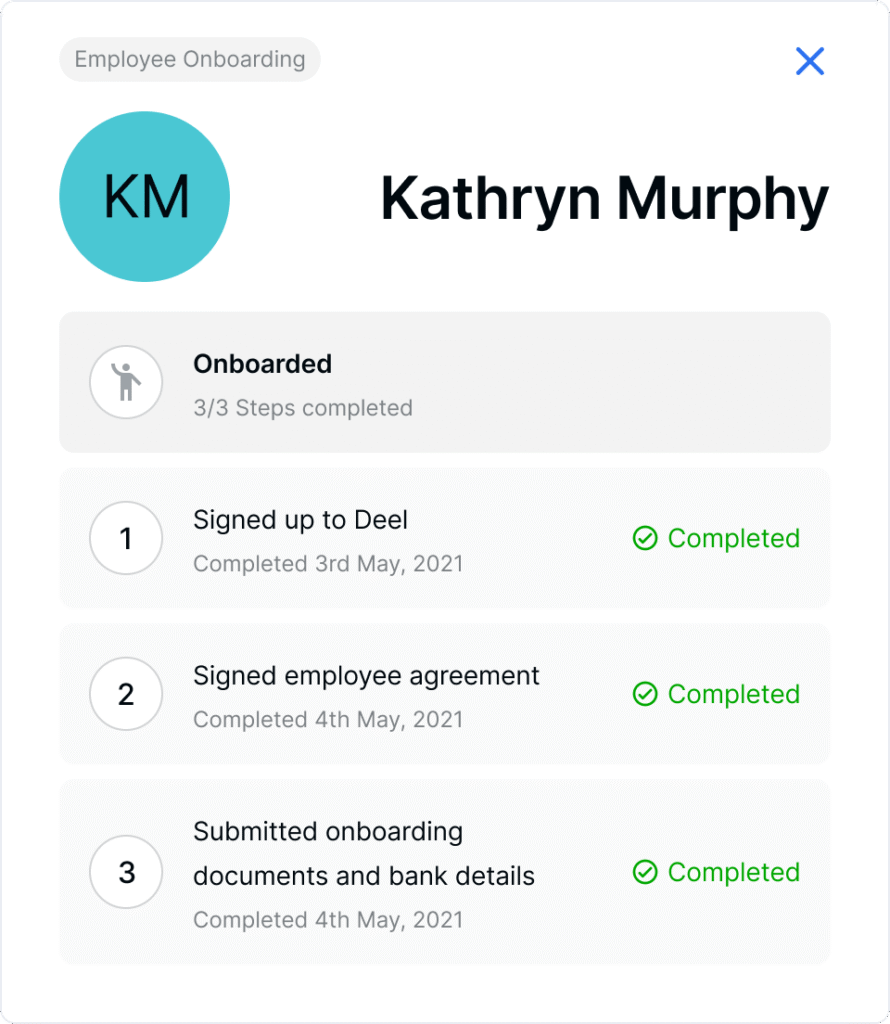
Deel automates the entire onboarding flow end-to-end. Once you initiate a hire, the platform generates locally compliant contracts and benefits enrollment without your HR team touching it. In most markets, the employer-side process takes hours, not days. Remote.com’s process takes around three business days after the employee completes self-enrollment, assuming documents come in clean. In complex markets like Brazil, India, or parts of MENA, both platforms push into the 5–7 business day range. For a team doing one or two hires a month, a two-day difference doesn’t move the needle. For a team doing 20+ hires across multiple countries in a quarter, it becomes a real operational bottleneck.
Payroll Depth
Deel runs payroll in-house across 130+ countries using its own infrastructure, supporting payments in 120+ currencies via bank transfer, Wise, Revolut, PayPal, or crypto. Remote.com operates global payroll across 100+ countries but routes payments through additional intermediaries in certain markets, which introduces extra steps in the payment chain. Independent reviewers describe Remote’s payroll configuration as less transparent and less customizable than Deel’s, particularly for finance teams that need detailed reporting.
Employee Self-Service
This is an area where Remote consistently comes out ahead in real-world feedback. G2 reviewers rate Remote’s employee-facing interface higher for payslip access, leave requests, and expense submissions, it’s designed with the employee in mind, not just the HR admin. Remote.com also keeps a full version history of every payroll and contract change: who made it, when, and what changed. For a distributed team with no local HR contact, that audit trail reduces support queries and builds employee trust in ways that don’t show up on a feature comparison checklist.
Integrations and Support Channels
Deel connects to 120+ tools: QuickBooks, Xero, NetSuite, Workday, BambooHR, Greenhouse, Lever, Slack, and Zapier, plus a full API for custom builds. Remote.com’s integration library is smaller but includes one partnership worth noting: Gusto users can hire internationally through Remote.com directly inside the Gusto interface, a genuine convenience for US-based companies that already run domestic payroll on Gusto.
On support channels, Remote.com offers phone support; Deel does not. On a normal Tuesday this doesn’t matter. When there’s a payroll failure or a compliance question that can’t wait for an email thread, it does.
| Integration / Support Feature | Deel | Remote |
|---|---|---|
| Accounting (QuickBooks, Xero, NetSuite) | ✅ | ✅ |
| HRIS (Workday, BambooHR, HiBob) | ✅ | ✅ |
| ATS (Greenhouse, Lever, Workable) | ✅ | ✅ Greenhouse, BambooHR |
| Workflow (Slack, Zapier) | ✅ | ✅ |
| Custom API | ✅ | ✅ |
| Phone Support | ❌ | ✅ |
| Gusto Partnership | ❌ | ✅ |
| Total Pre-built Integrations | 120+ | Fewer, growing |
Sources: Rippling blog Feb 2025 · OutSail Jan 2026 · SelectSoftwareReviews Apr 2026
Compliance Tooling
Deel leans on automation: it tracks regulatory changes in 150+ countries and updates contract templates when local law shifts. Its misclassification tooling comes with real-time alerts, and its optional Deel Premium product covers up to $25,000 per contract in misclassification liability for $99/month, useful for companies carrying a large contractor base.
Remote uses Compliance Watchtower, monitored by its in-house legal team rather than automated detection alone. The difference matters in markets where the important regulatory change is the one that doesn’t fit neatly into a rule set, and there are more of those than you’d expect in parts of Southeast Asia, Latin America, and Sub-Saharan Africa. Importantly, Remote.com launched AI-driven payroll automation across 100+ countries in May 2025, so the automation gap between the two platforms is narrower than it was a year ago.
6. Data Security: Both Pass; Remote’s Documentation Goes Deeper
Both platforms will clear a standard enterprise security review. Deel holds SOC 1, SOC 2, SOC 3, ISO 27001, and GDPR compliance. Remote holds SOC 2 Type 2 and ISO 27001 certification, with its attestation report published at trust.remote.com. Both enforce quarterly security training, restrict customer data on a need-to-know basis, and support SCIM-based automated user provisioning.
Where they differ is documentation depth. Remote’s Trust Center is consistently described by IT security reviewers as more thoroughly organized, with clearer audit trails and SCIM documentation that enterprise security teams can evaluate without extensive back-and-forth. Deel’s security posture is solid, but verifying which payroll flows use Deel’s own infrastructure versus third-party processors requires additional questions during procurement. For most companies this is a minor issue. For enterprises in financial services, healthcare, or public-sector-adjacent industries doing formal vendor assessments, Remote’s documentation reduces the review timeline.
7. The Switching Cost Nobody Thinks About When They’re Signing Up
Most buyers approach EOR evaluation as a one-time decision. It usually is, but it’s worth understanding what switching costs look like upfront, because they’re higher than the per-seat math implies.
Changing EOR providers means terminating and rehiring every employee. For a 15-person team across three countries, expect a 2–4 week transition window where benefits lapse, leave balances need manual migration, and work permits may be temporarily uncertain. Employees in markets with strict statutory notice requirements may trigger severance calculations during the termination step, even when the underlying role continues. If any team members hold employer-sponsored visas, common for engineering hires in the US, UK, or Canada, visa status may be disrupted during the handoff between legal entities.
Neither Deel nor Remote makes this easy to find in their marketing materials. Ask both vendors explicitly during your evaluation: what does your off-boarding and transition process look like? The quality of that answer tells you something.
8. Which Platform Fits Your Stage
Early-stage (0–25 international hires): Remote’s contractor pricing ($29/month), no security deposit, and compliance depth make it the more financially conservative entry point. At this stage, the cost of a misclassification problem is proportionally much higher, and the cash Deel ties up in deposits is cash a young company needs elsewhere.
Scaling companies (25–200 international hires): Deel is the stronger fit. Onboarding automation, 120+ integrations, the expanding all-in-one product suite, and AI-driven compliance tooling reduce HR team overhead as headcount grows. The litigation risk is a real procurement consideration, but for most growth-stage operators, it doesn’t outweigh the operational advantages.
Enterprise (200+ hires, regulated industries): Remote’s 100% owned-entity model, thoroughly documented Trust Center, IP Guard framework, and phone support are a better match for enterprises in financial services, healthcare, legal, or government-adjacent industries, where legal structure and documented compliance carry as much weight as the product itself. Deel’s enterprise tier is competitive, but the combination of opaque entity-model disclosure and an active DOJ investigation creates procurement friction at this level that is worth taking seriously.
9. Support: Honest Summary
Both platforms offer 24/7 support. G2 and Capterra data from 2025–2026 shows a consistent pattern: Deel’s AI-first triage is fast and effective for routine questions, contract renewals, onboarding status, payment tracking. For anything involving nuanced compliance, a complex termination, a misclassification question, an edge-case labor law interpretation, standard-tier accounts run into slow escalation, multiple handoffs, and email resolution times of 3–5 business days.
Remote’s support reviews skew more positive on compliance responsiveness. The platform routes complex questions to onboarding specialists and in-country employment experts, and the phone line exists for situations where an email queue isn’t acceptable. The downside: some users report inconsistent support contacts over time and payment delays of 5+ days in certain markets.
The honest summary: use Deel for volume and speed, Remote for depth when it matters.
10. Final Verdict
Deel closed March 2026 at approximately $1.4 billion in annualized revenue, up 63% year-over-year, with three consecutive profitable years and a 16% EBITDA margin in 2025. That kind of financial position funds product development at a pace Remote, last valued at $3 billion in 2022, on $506 million in total raised, simply can’t match dollar for dollar. The product gap between these two platforms is already visible in the feature table above. It will likely widen further.
Remote’s response to that dynamic is to be structurally different rather than financially competitive: fully owned entities in every covered market, deeper compliance expertise, IP protection, no security deposit, phone support, no active litigation, and better contractor pricing. For a specific type of buyer, those things are worth more than a broader feature set.
Choose Deel if:
- You’re growing fast across multiple countries and need wide coverage with fast time-to-hire
- You want payroll, HRIS, performance management, IT provisioning, and equity management under one roof
- Your international team is primarily full-time employees rather than contractors
- Platform consolidation is part of your longer-term operational strategy
- Automation depth and onboarding speed are real daily priorities, not nice-to-haves
Choose Remote if:
- You’re in a regulated industry where 100% owned-entity legal structure is a hard requirement
- IP protection for international engineering hires is a board-level concern
- Your international workforce skews toward contractors, the $29/month rate adds up in your favor
- You already run domestic US payroll on Gusto and want a clean international extension
- You’re early-stage and Deel’s security deposit would strain your cash position
- Legal certainty and compliance depth matter more than product breadth right now
Conclusion
Both platforms do the core job well. The decision comes down to which failure mode you’re less willing to accept: a product gap that slows your team down, or a legal gap that creates exposure.
For most scaling companies in 2026, Deel covers more ground. Remote covers its ground more slowly. Pick the one that matches your actual risk tolerance, not the one with the better demo.